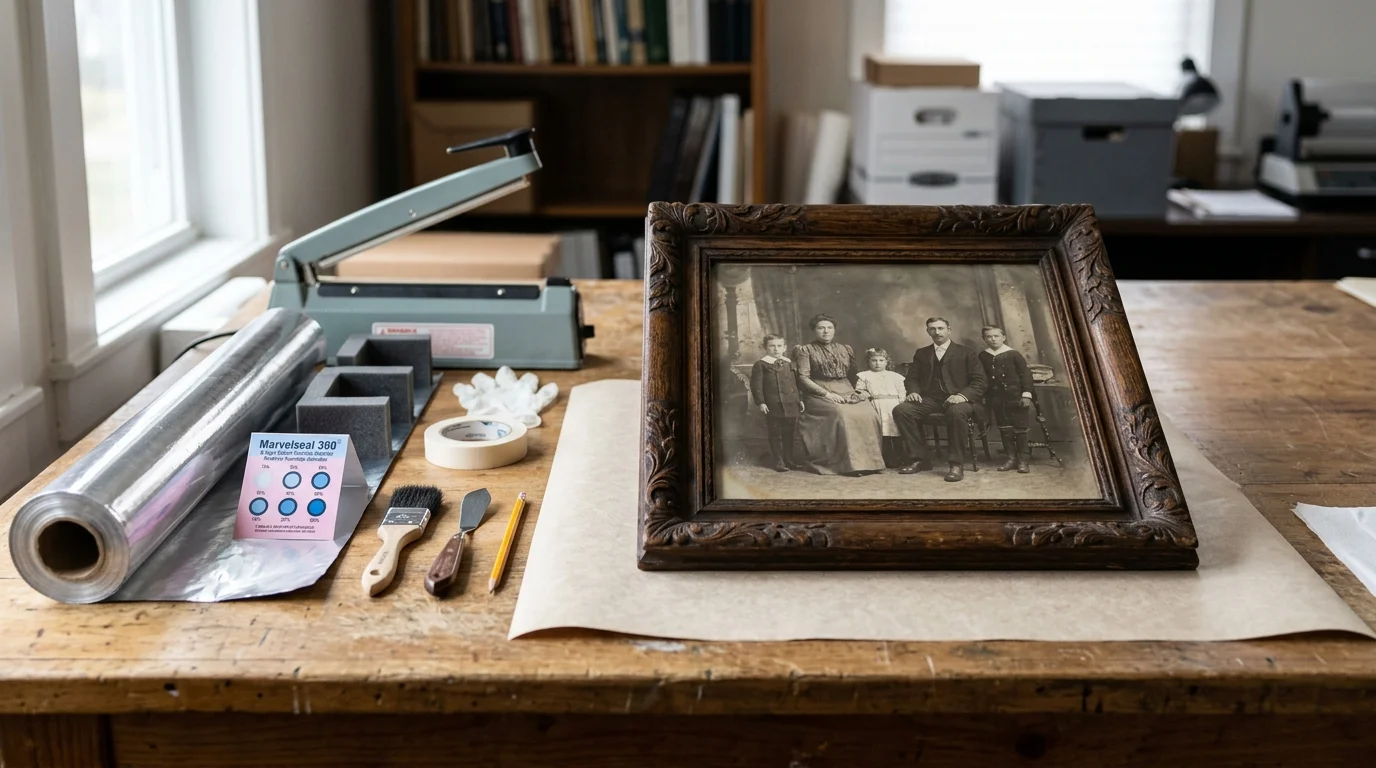
Preparing fifteen framed heirloom portraits for a military relocation to humid Okinawa requires active environmental isolation. Standard movers wrap frames in bubble wrap, but ocean freight turns sealed frames into moisture traps that destroy fragile emulsions.
True preservation during international sea transit demands engineered microclimates using heat-sealed vapor-barrier films and interior relative humidity indicator cards. This guide details how to construct stable internal micro-environments that survive weeks at sea.
By buffering each portrait individually, you protect silver gelatin prints and antique frames against catastrophic tropical moisture cycling.
The Ocean Transit Threat: Understanding Container Rain and Frame Microclimates
Dry-van shipping containers crossing the Pacific endure brutal environmental shifts. Interior cargo temperatures swing between 10°C (50°F) at night and 60°C (140°F) during sunny daytime crossings.
When moist tropical air cools inside a steel container, relative humidity surges to 100 percent. In a standard 40-foot container loaded at 30°C and 80 percent humidity, cooling drops over 1,100 grams of liquid water onto cargo.
This phenomenon, known as container rain, creates puddles and drenches exterior packaging. Corrugated cardboard boxes soften rapidly under these conditions, losing up to 70 percent of their structural stacking strength.
Even worse than external condensation is the microclimate trapped inside a picture frame. Glazed frames that lack vapor sealing exchange humid air through gaps in their wooden backing boards.
Solar radiation warms the framed air, which expands and draws in saturated maritime humidity. When evening temperatures plunge, that trapped vapor condenses directly against the interior surface of the cold glazing.
Liquid droplets pool along the lower mat margin and photographic emulsion. Moisture activates latent fungal spores within hours, starting irreversible bio-deterioration across irreplaceable vintage photographic emulsions.
According to the Image Permanence Institute, fungal spores on photographic gelatin emulsions begin active germination once relative humidity exceeds 65 percent.
When damp gelatin swells against picture glass, it fuses permanently to the smooth glazing. Conservators call this catastrophic bonding ferrotyping; removing the photograph later destroys the emulsion layer completely.
Albumin prints, cyanotypes, and silver gelatin portraits react differently to prolonged dampness. Silver silvering, emulsion softening, paper cockling, and foxing stains accelerate exponentially under warm, humid sea-freight conditions.
Dismantling Versus Direct Packing: Evaluating Glazing and Matting Risks
You must decide whether to pack framed portraits intact or dismantle them before shipping. Dismantling eliminates glass breakage risks, but reassembling historic frames in an apartment overseas presents practical hurdles.
Vintage photographs framed without window mats present the highest transit risk. If an un-matted print rests against glass, any humidity spike causes immediate adhesion and irreversible chemical staining.
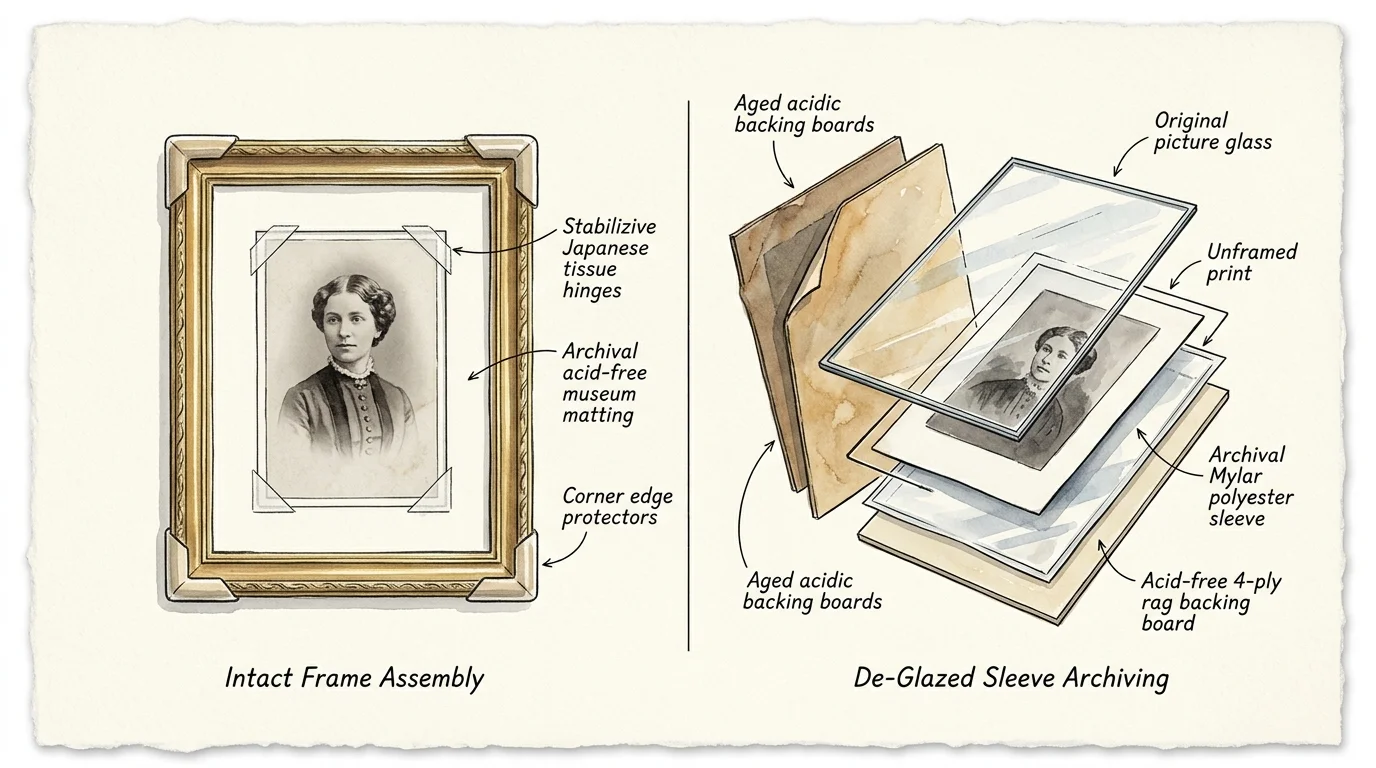
If your portraits sit in direct contact with glass, dismantle them before transit. Remove the print carefully and place it inside an archival polyester sleeve supported by acid-free mat board.
For prints properly separated by four-ply rag window mats, packing intact portraits remains viable. The mat board provides a necessary air cushion and acts as a minor humidity buffer during transit.
Standard picture glass remains dangerous under sea freight conditions because heavy mechanical vibration causes microscopic stress fractures. Acrylic glazing such as Plexiglas does not shatter, but it permits higher moisture vapor transmission than glass.
If you retain standard glass, apply professional glass masking film across the entire pane. High-tack artist glass tape secures shattered fragments in place, preventing loose shards from piercing the historic photograph beneath.
Never apply standard duct tape or brown packaging tape directly to glass or frame moldings. Rubber-based adhesives bake into glass under container heat, releasing acidic solvent vapors into the frame package.
Carefully inspect your frame moldings for unstable gesso, loose gold leaf, or weakened corner joints. Fragile 19th-century plaster ornamentation demands custom internal padding to prevent transit vibration from crumbling delicate historic profiles.
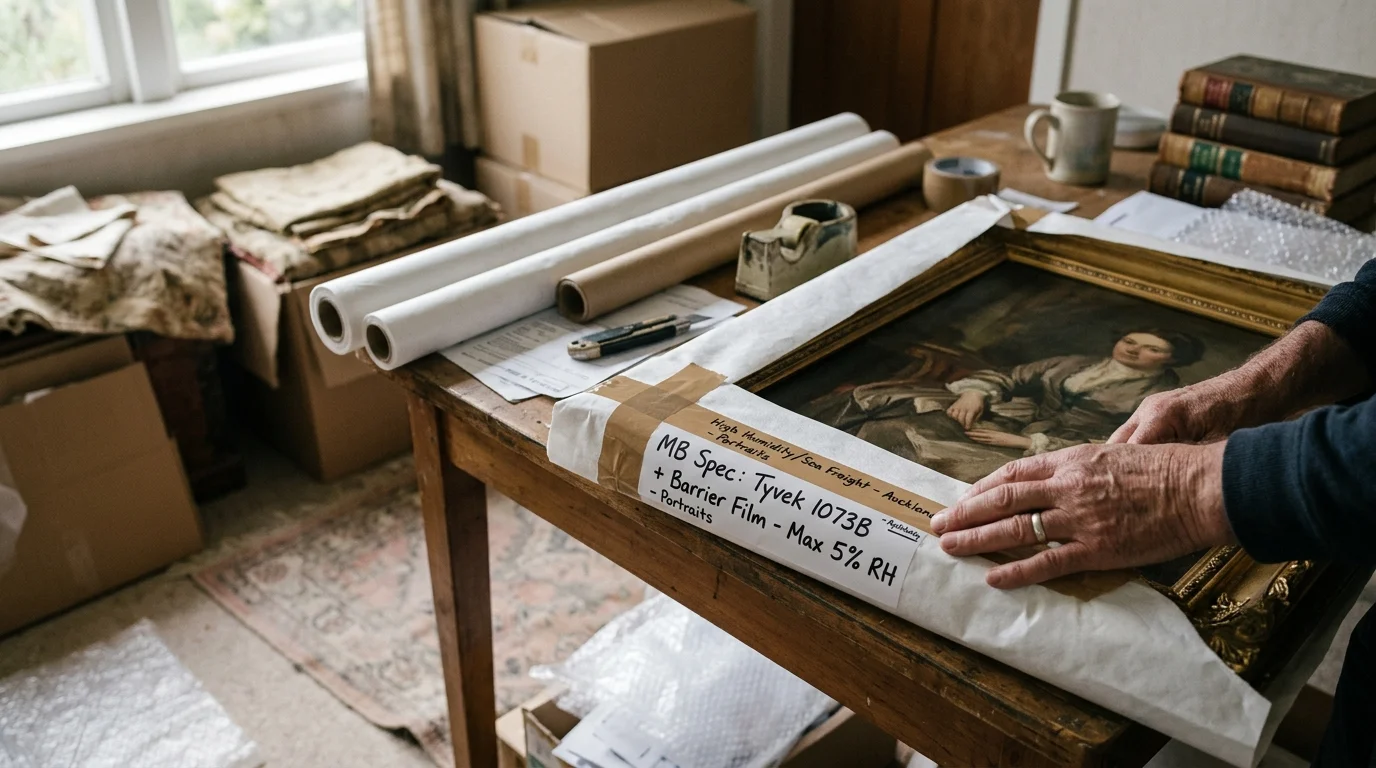
Moisture Barrier Performance: Material Specifications and Selection
Standard packaging supplies offer zero defense against maritime humidity. Common polyethylene stretch wrap and single-layer bubble wrap allow moisture vapor to pass through their thin plastic structures within hours.
You need engineered vapor-barrier materials rated for ocean freight exposure. Moisture vapor transmission rate (MVTR) measures how many grams of water penetrate one square meter of material in 24 hours.
| Barrier Material | Thickness (Mil) | MVTR (g/m²/24hr at 38°C/90% RH) | Maritime Protection Window | Archival Safety Rating |
|---|---|---|---|---|
| Commercial Stretch Film | 0.8 mil | 18.50 to 25.00 | Under 12 hours | Unacceptable (plasticizer outgassing) |
| Standard LDPE Sheeting | 4.0 mil | 4.20 to 6.10 | 3 to 5 days | Moderate (requires desiccant) |
| Heavy-Duty Virgin Polyethylene | 6.0 mil | 2.10 to 3.20 | 14 to 21 days | Archival Grade (chemically inert) |
| MIL-PRF-131 Class 1 Foil Laminate | 4.5 mil | 0.005 to 0.020 | Over 180 days | Maximum Archival Isolation |
For transpacific shipments to sub-tropical ports like Naha, Okinawa, four-mil polyethylene remains insufficient for prolonged storage delays. Container ships often anchor off ports during typhoon season, exposing cargo to extended saturated conditions.
Use six-mil virgin low-density polyethylene (LDPE) or MIL-PRF-131 foil laminates for your outer barrier bags. Virgin polyethylene contains no slip additives, recycled resins, or migratory plasticizers that could outgas and damage photographic emulsions.
Aluminized barrier foils offer absolute moisture vapor isolation, but they prevent visual inspection of your portraits. Heavy-duty six-mil clear LDPE allows continuous visual monitoring of internal humidity indicator cards without opening sealed enclosures.
Never substitute PVC vinyl or household construction plastic for archival barrier films. PVC degrades rapidly, off-gassing hydrochloric acid that attacks photographic silver, brittle paper fibers, and antique frame finishes.
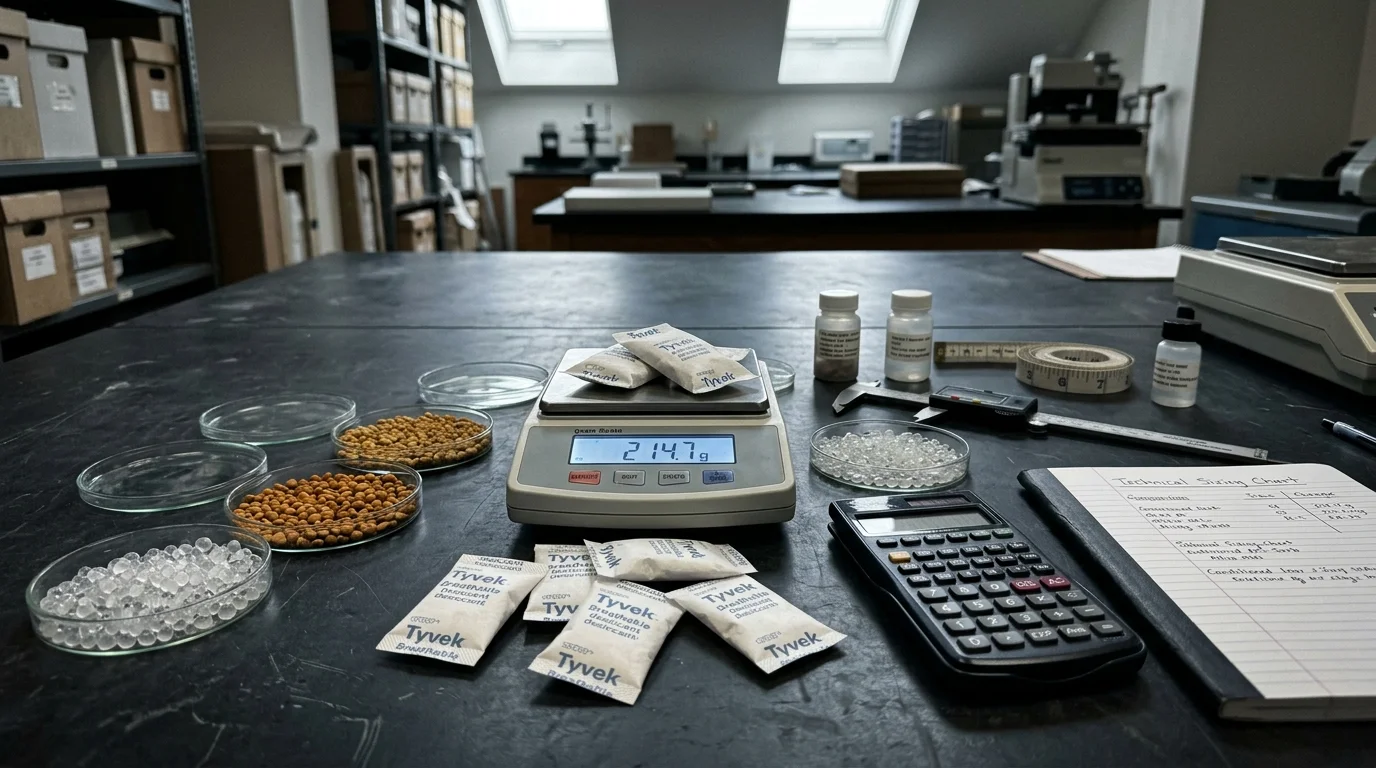
Desiccant Engineering: Sizing Adsorption for Maritime Freight
Sealing a portrait inside vapor-barrier film traps whatever ambient humidity exists during packing. You must add active desiccant pouches to maintain internal humidity between 30 and 50 percent relative humidity.
Standard silica gel pouches adsorb roughly 30 to 40 percent of their weight in moisture at high humidity. Military specification MIL-D-3464E defines one desiccant unit as approximately 28 grams of active silica gel.
Under international maritime standards, calculating desiccant needs depends on barrier surface area and transit duration. For rigid barrier enclosures made of six-mil LDPE, use 1.2 desiccant units per cubic foot of interior volume.
Never let desiccant packets touch the surface of a vintage photograph, wooden frame, or decorative gilding. Direct contact can cause localized over-drying, resulting in wood cracking, canvas contraction, or emulsion flaking.
Select desiccant packaged exclusively in non-dusting Tyvek pouches rather than porous kraft paper. Kraft paper packets can abrade delicate frame moldings and burst under mechanical vibration inside shipping crates.
Pre-condition your silica gel packets to 40 percent relative humidity before sealing them inside packages. Placing bone-dry, zero-percent desiccant beside century-old photographs desiccates paper backings, making vintage fibers brittle and prone to structural cracking.
Place Cobalt-free relative humidity indicator cards inside every sealed package. These cards display distinct color transitions at 30, 40, and 50 percent relative humidity, giving you instant proof of interior environment health.
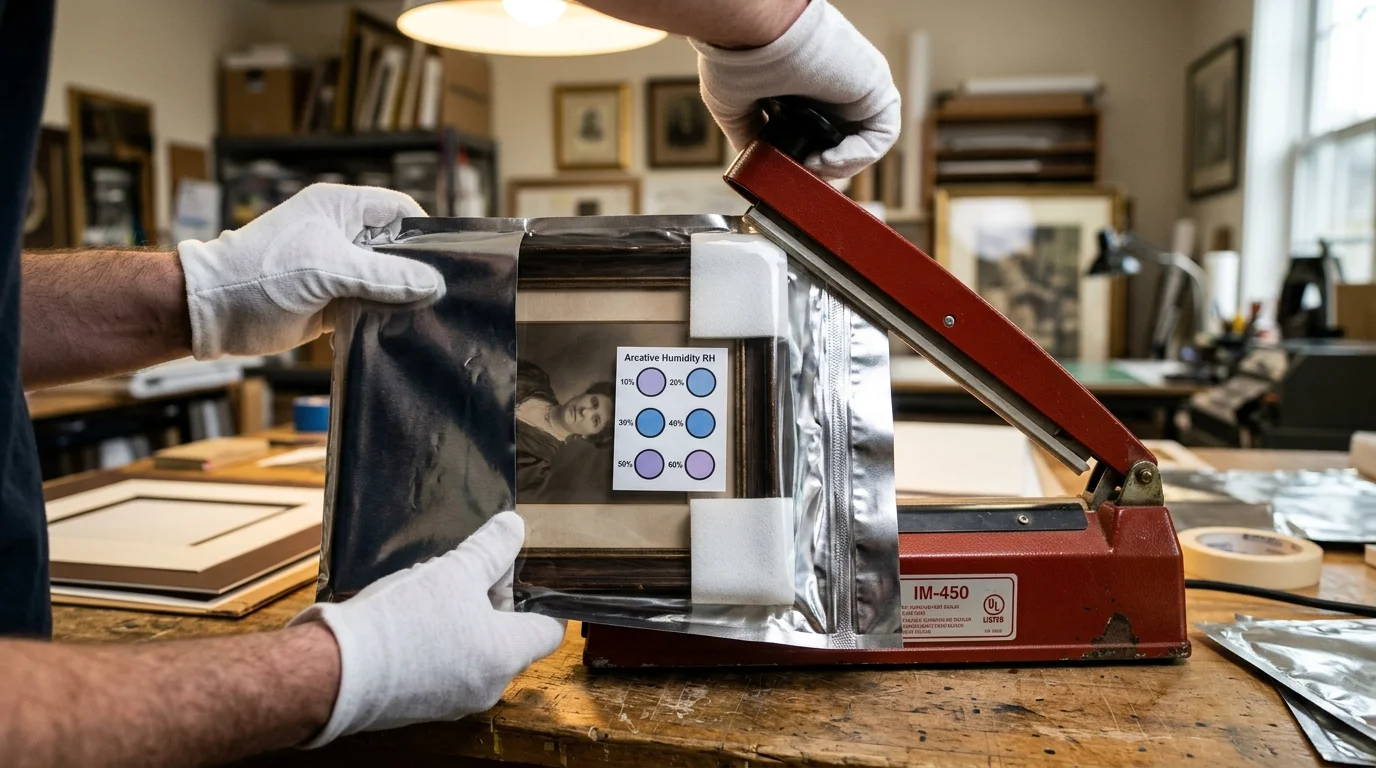
Step-by-Step Archival Encapsulation and RH Card Placement
Begin your packing protocol in an air-conditioned room maintained between 20°C and 22°C (68°F–72°F) and 45 percent humidity. Working in an air-conditioned room prevents sealing hot, humid baseline air into your barrier envelopes.
Inspect the frame corners and glazing for loose debris, cleaning exterior glass with an ammonia-free cleaner. Never spray cleaners directly onto glazing; dampen an unbleached microfiber cloth to keep liquid from seeping beneath frame rabbits.
Apply acid-free corner protectors over all four corners of each frame. You can fold these from archival four-ply rag board or purchase pre-folded neutral-pH folding board protectors to absorb handling shocks.
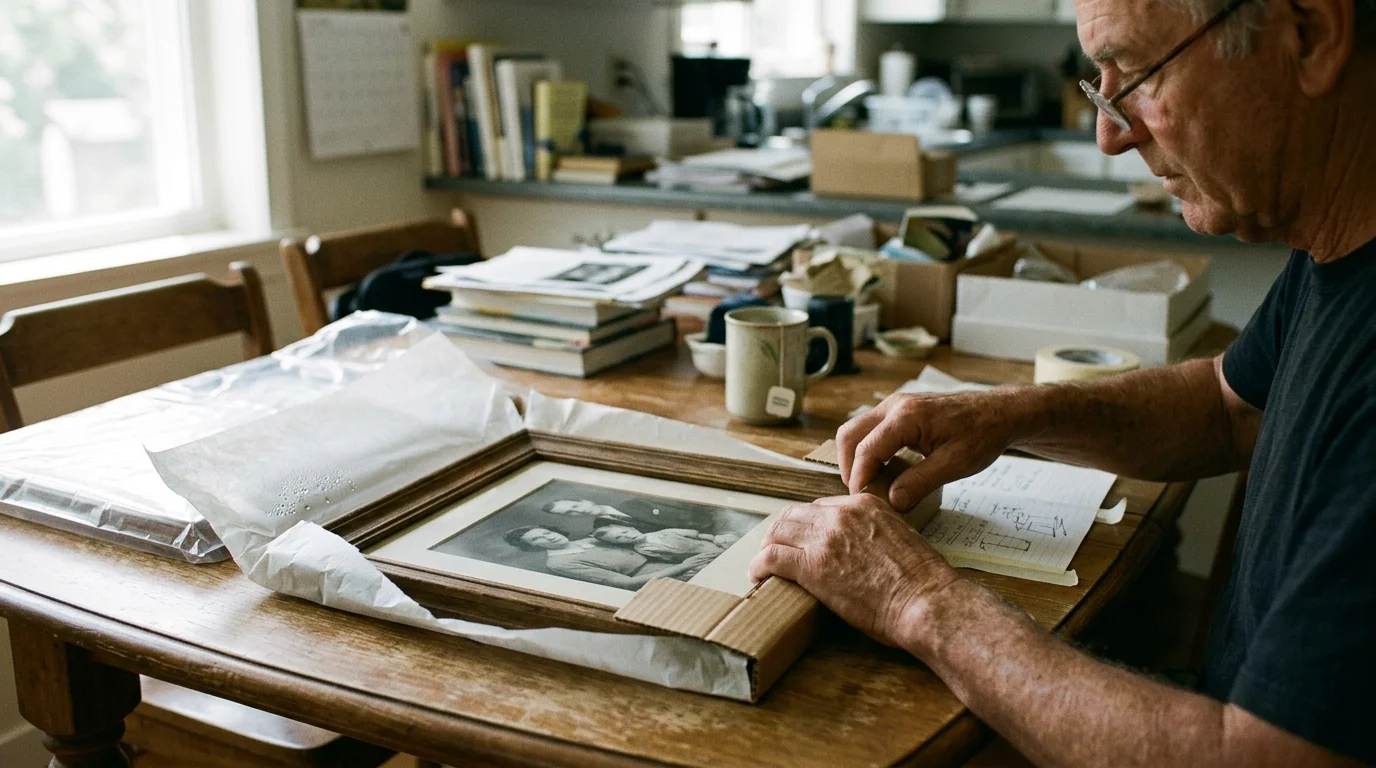
Wrap the entire framed portrait in unbuffered, acid-free tissue paper following preservation guidelines from the American Institute for Conservation. Secure the tissue folds using conservation-grade archival paper tape rather than pressure-sensitive masking tape.
Slide the wrapped portrait into a custom-cut pouch made of six-mil virgin LDPE sheeting. Position a three-spot relative humidity indicator card against the tissue wrap, facing outward through the clear plastic.
Nestle your calculated Tyvek silica gel packets around the exterior edges of the frame. Use acid-free paper tape to fix desiccant packs securely along the frame perimeter so they cannot migrate over glazing.
Extract excess ambient air from the plastic pouch by pressing gently across the surface with clean cotton gloves. Do not pull a mechanical vacuum, which places severe stress on glass panes and fragile frame joints.
Seal the open edge using an impulse heat sealer set to 3.5 seconds dwell time. Verify the heat seal creates a continuous, bubble-free plastic weld along the entire seam to prevent moisture ingress.

Worked Example: Packing 15 Vintage Portraits for an Okinawa Relocation
Consider an apartment renter preparing fifteen framed heirloom family portraits for a military sea move to Okinawa. The collection contains six 8×10-inch frames, six 11×14-inch frames, and three 16×20-inch ornate vintage frames.
Total encapsulated internal volume across the fifteen packages equals 4.2 cubic feet. Applying our maritime factor of 1.2 units per cubic foot indicates a minimum requirement of 5.04 total desiccant units.
To ensure balanced buffering, divide desiccant units proportionally among individual portrait envelopes:
- Six 8×10-inch frames: One 10-gram Tyvek silica gel packet per frame (0.35 units each).
- Six 11×14-inch frames: One 15-gram Tyvek silica gel packet per frame (0.53 units each).
- Three 16×20-inch frames: Two 20-gram Tyvek silica gel packets per frame (1.42 units total per large frame).
Total materials required for this fifteen-portrait project:
- One 12-inch electrical impulse heat sealer: $42.00
- One roll of 6-mil virgin LDPE barrier film (100 feet × 24 inches): $48.00
- One pack of 25 Cobalt-free 3-spot (30%-40%-50%) RH indicator cards: $18.50
- Thirty 10-gram pre-conditioned Tyvek silica gel pouches: $24.00
- One hundred sheets of unbuffered acid-free tissue (24×36 inches): $32.00
- Four sheets of 1/2-inch exterior CDX plywood for custom crating: $96.00
- Two sheets of 2-inch closed-cell polyethylene foam (Ethafoam 220): $65.00
Total financial investment for materials equals $325.50. Preparing each frame requires approximately 30 minutes of careful wrapping, card placement, and heat sealing.
Packaging all fifteen portraits takes roughly 7.5 hours over one weekend. Custom crate construction and interior foam cushioning require an additional four hours of workshop preparation.
This systematic investment prevents thousands of dollars in professional restoration fees. More importantly, it safeguards irreplaceable 19th-century family history against irreparable tropical mold degradation.
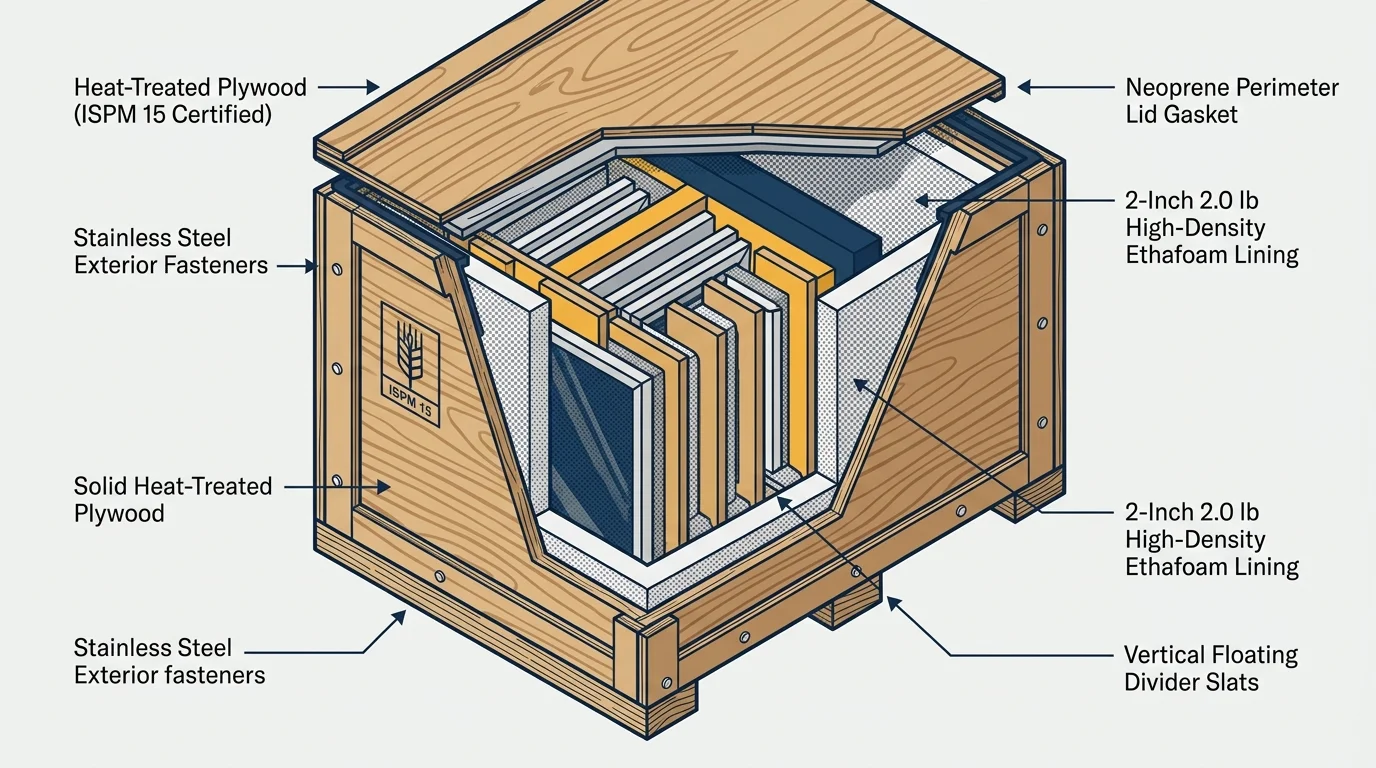
Crating Standards: ISPM 15 Compliance and Exterior Cushioning
Do not ship sealed portraits internationally inside standard moving boxes or unreinforced wooden crates. Ocean transit subjects cargo to severe pitching, mechanical vibration, and heavy container-stacking pressures.
If you build or commission a solid wooden shipping crate, international law requires strict pest-control compliance. The International Plant Protection Convention enforces standard ISPM 15 on solid wood packaging components exceeding six millimeters thickness.
Solid lumber must undergo certified heat treatment to a minimum core temperature of 56°C for 30 minutes. Regulators require an official IPPC ink stamp verifying heat treatment (marked HT) displayed visibly on exterior crate panels.
Crates lacking the required IPPC stamp face immediate customs quarantine, chemical fumigation, or destruction upon arrival in Japan. Customs fumigation utilizes methyl bromide gas, which permanently damages photographic silver and yellows historic rag paper.
You can bypass ISPM 15 export regulations entirely by building shipping crates out of engineered wood products. Exterior-grade plywood, oriented strand board (OSB), and Masonite are processed with high heat and pressure, exempting them from fumigation mandates.
Line the interior of your plywood crate with two inches of closed-cell polyethylene foam, such as Ethafoam 220. Closed-cell foam absorbs mechanical drop shocks and provides high thermal insulation without absorbing ambient container moisture.
Pack encapsulated portraits vertically on their edges like books on a library shelf. Never lay framed portraits flat; horizontal stacking concentrates shock vibrations across glass panes, increasing breakage risks dramatically.
Insert sheets of corrugated plastic (Coroplast) between each encapsulated portrait inside the crate. Coroplast dividers create isolated transit channels, preventing heavy antique frames from rubbing against adjacent artwork during high-seas pitching.
Acclimatization and Unpacking Protocols in High-Humidity Climates
Your sea freight shipment will arrive in subtropical destinations during periods of peak outdoor humidity. Okinawa regularly records ambient outdoor humidity levels between 80 and 95 percent during summer deployments.
Never unseal your shipping crate or barrier bags immediately inside an unconditioned warehouse or open garage. Warm outdoor air will condense on cool portraits, ruining your weeks of preservation efforts instantly.
Move the unopened shipping crate into your air-conditioned apartment or base housing. Allow the entire sealed crate to acclimatize unopened for at least 48 hours, equalizing internal temperatures safely.
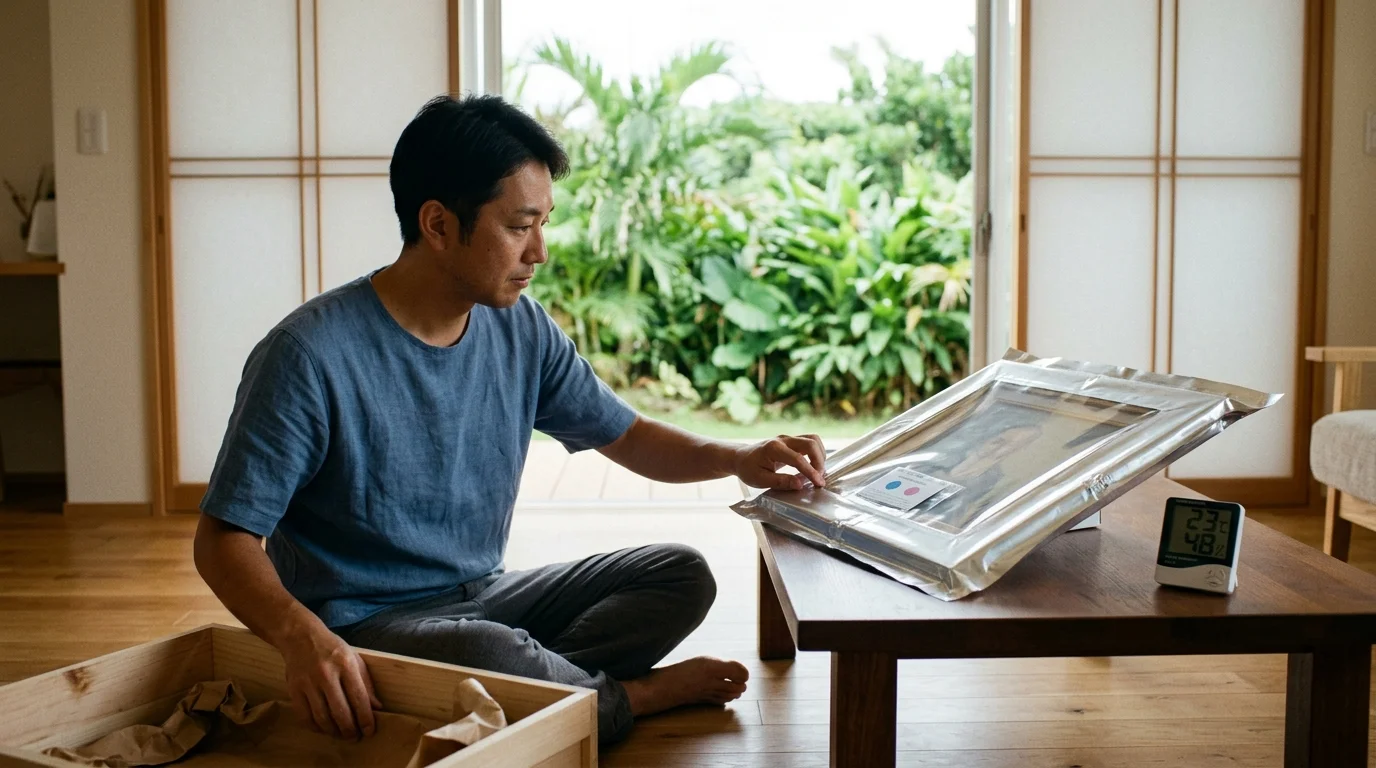
Following temperature equilibration, unfasten the crate lid and inspect your individual six-mil poly barrier pouches. Examine the internal relative humidity indicator card through the transparent plastic before cutting any seals.
If the indicator card displays a bright blue 30 percent spot, the interior microclimate remained secure. You can safely cut the heat seal with scissors and remove the portrait into the conditioned room.
If the indicator card shows a pink 50 percent spot, moisture breached the outer barrier film during transit. Keep the portrait inside the bag and place supplemental fresh desiccant alongside it for 24 hours.
Guidance from the Library of Congress Preservation Directorate emphasizes slow environmental transitions for antique paper. Gradual moisture release prevents fiber curl, ink flaking, and structural warp across vintage mounts.
Maintain your residential interior climate between 45 and 55 percent relative humidity using dedicated dehumidifiers. Never hang historic photographs directly against uninsulated exterior concrete walls, which conduct outside moisture directly into framed backings.
Frequently Asked Questions
Can I use standard vacuum seal bags to pack framed photos for ocean freight?
No, you should never use household vacuum seal bags on framed artwork. Vacuum suction exerts massive pressure across glass panes, fracturing vintage glass and crushing historic plaster frames.
Is silica gel safe to put directly behind a framed photograph?
Silica gel must never touch photographic paper or wooden frame backings directly. Isolate silica gel packets along the outer frame perimeter using Tyvek envelopes to prevent localized desiccation damage.
Why is plywood exempt from international ISPM 15 shipping regulations?
Plywood is exempt from ISPM 15 because manufacturing processes utilize industrial glues, high pressures, and extreme heat. These manufacturing steps destroy wood-boring pests and plant pathogens, eliminating the need for customs heat-treatment stamps.
What should I do if an indicator card turns pink during transit?
A pink indicator card indicates internal humidity reached 50 percent or higher. Do not unpack the frame in humid air; move it into a dehumidified room and add fresh desiccant.
Disclaimer: This article is for informational purposes only. When handling valuable or irreplaceable photographs, consider consulting a professional conservator. Always test preservation methods on non-valuable items first.