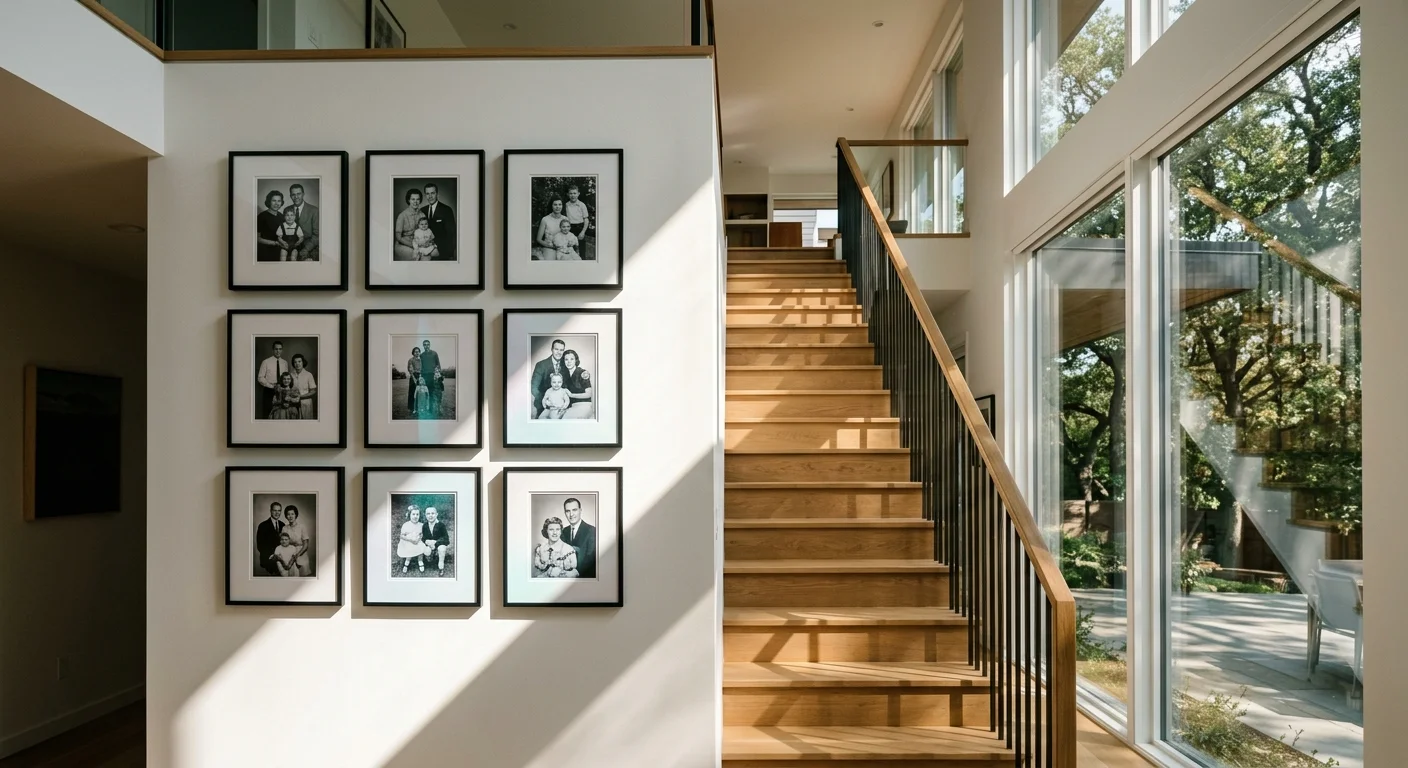
Hanging historic family portraits along a south-facing staircase with double-height windows exposes delicate silver gelatin emulsions to aggressive photochemical fading. You must calculate daily luminous exposure alongside UV wavelengths to prevent irreversible print bleaching.
Implementing the right framing strategy is a core part of protecting your prints against environmental degradation throughout your home.
While standard 99% UV glass blocks ultraviolet energy, ambient visible light exceeding 50,000 lux will still destroy organic dyes through radiant heating and light-induced oxidation. True preservation requires managing both spectrums simultaneously.
Selecting between Tru Vue Museum Glass and Tru Vue Optium Museum Acrylic requires balancing optical glare angles, shear wall weight limits, and material costs per square inch. Here is how to evaluate the math for your staircase gallery.
The Solar Threat: Calculating Lux and UV Dosage on a South-Facing Staircase
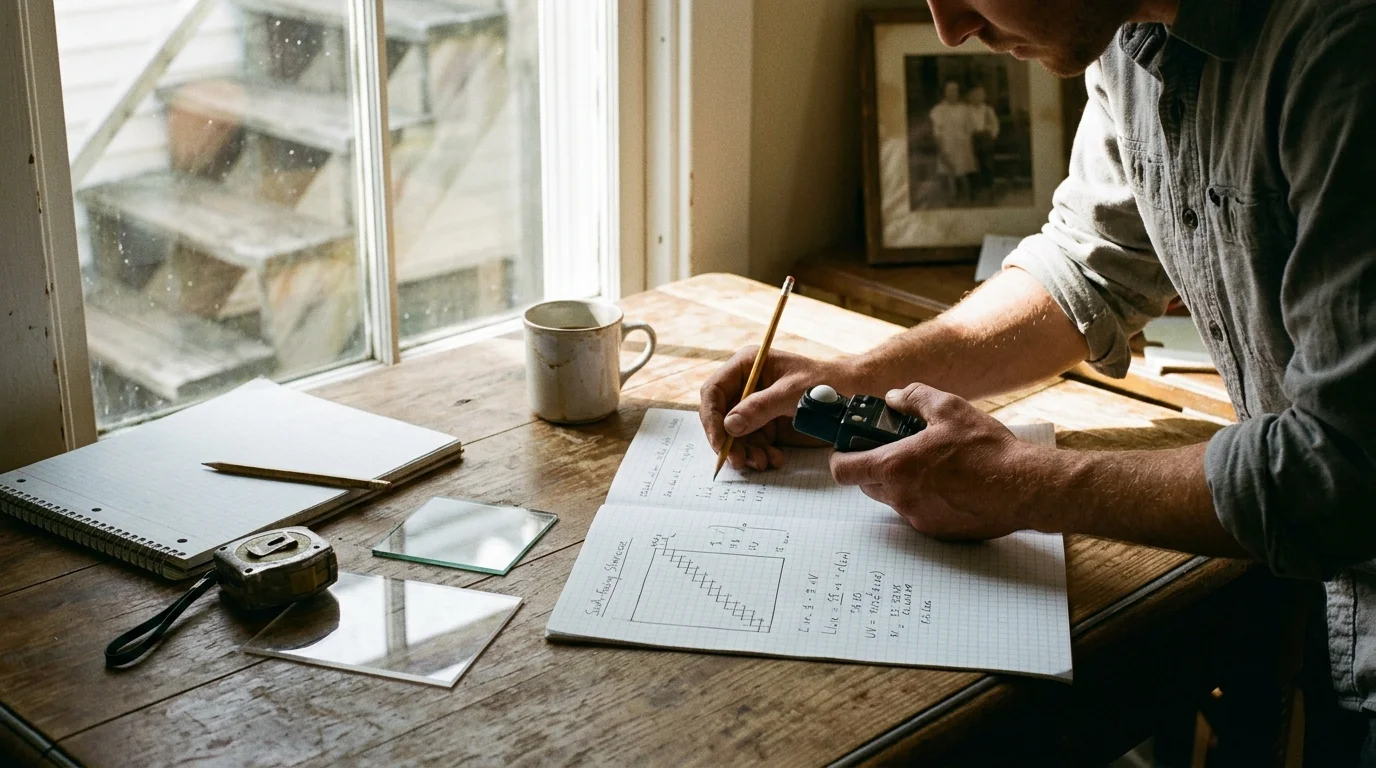
South-facing windows act as giant light collectors throughout the entire day. Unshaded double-height picture windows routinely admit between 40,000 and 80,000 lux of direct sunlight across an open stairwell.
For irreplaceable original prints that exceed these light thresholds, you may want to rotate them periodically into dark archival print storage while displaying high-quality facsimiles.
Even indirect bounce light off white stairwell drywall easily registers 5,000 to 12,000 lux. By contrast, conservation standards published by the Image Permanence Institute recommend display light levels of no more than 50 to 100 lux for sensitive photographic emulsions.
Photochemical damage follows the Bunsen-Roscoe Law of Reciprocity. This law states that total photochemical alteration equals light intensity multiplied by exposure duration.
A family portrait exposed to 5,000 lux for 4 hours receives 20,000 lux-hours of light dosage per day. Over one single year, that frame absorbs 7.3 million lux-hours of luminous radiation.
Silver gelatin prints tolerate around 240,000 lux-hours per year under museum conditions before measurable yellowing occurs. At 7.3 million lux-hours, your portrait absorbs thirty times its recommended annual allowance every twelve months.
Ultraviolet radiation represents the most energetic band of the solar spectrum reaching your walls. UV rays between 300 and 380 nanometers possess sufficient photon energy to shatter chemical bonds in albumen, silver gelatin, and chromogenic color couplers directly.
Ordinary framing glass filters out UVB wavelengths below 315 nanometers but transmits up to 55% of destructive UVA rays between 315 and 380 nanometers. This UVA penetration causes binder embrittlement and base yellowing.
Visible blue light between 400 and 500 nanometers also drives degradation through photo-oxidation. Glazing that filters only UV light still leaves your portraits completely unprotected against this high-energy visible spectrum.
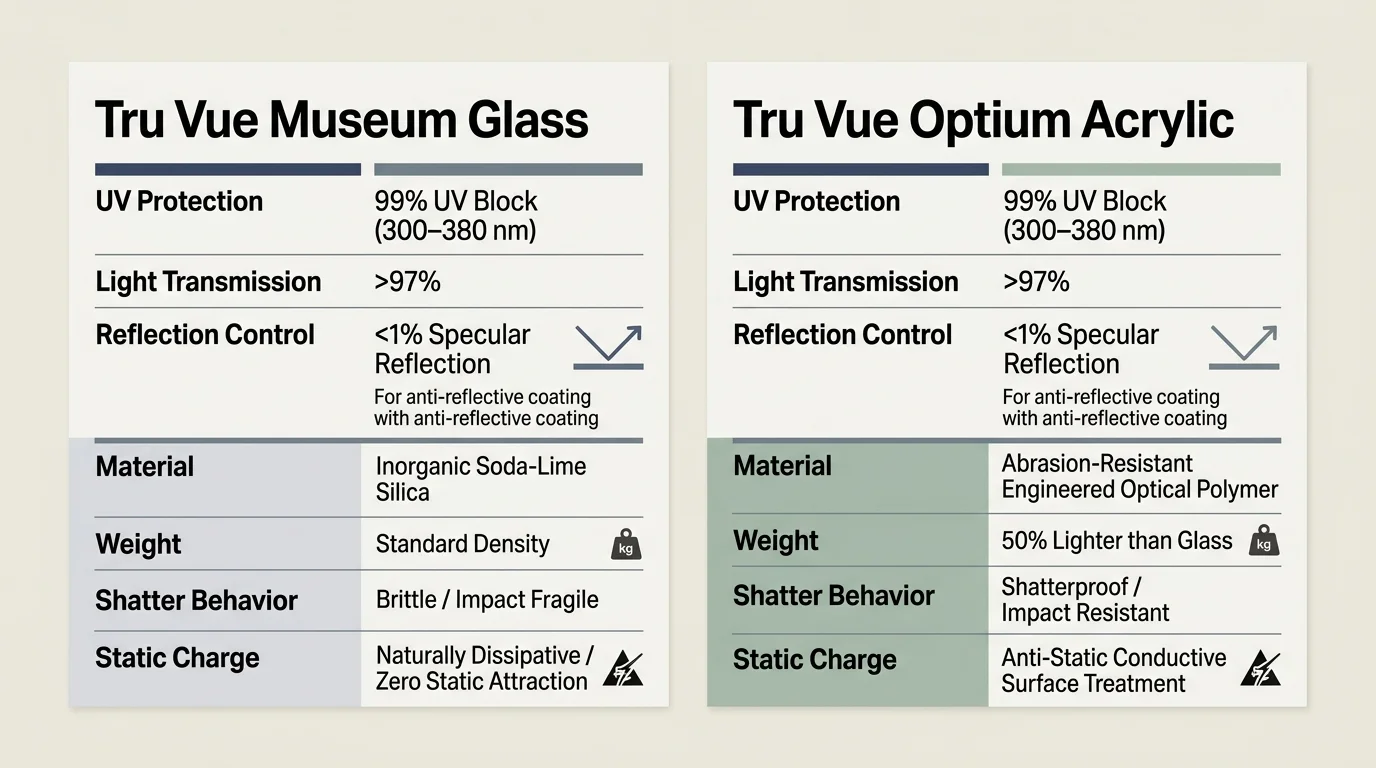
Technical Glazing Metrics: Tru Vue Museum Glass vs. Tru Vue Optium Acrylic
When selecting professional archival glazing, two primary materials lead the preservation framing sector. These are Tru Vue Museum Glass and Tru Vue Optium Museum Acrylic.
Both products provide conservation-grade ultraviolet protection, but they differ significantly across physical structure, optical behavior, and chemical stability. The table below details their exact operational metrics.
| Metric | Standard Float Glass | Tru Vue Museum Glass | Tru Vue Optium Museum Acrylic |
|---|---|---|---|
| UV Filtration (300–380 nm) | 45% to 50% | Up to 99% | Up to 99% |
| Visible Light Transmission | 89% to 91% | >97% | >98% |
| Double-Sided Reflection | ~8.0% | <1.0% | <1.6% |
| Weight (3.0 mm sheet) | 1.45 lbs / sq. ft. | 1.45 lbs / sq. ft. | 0.70 lbs / sq. ft. |
| Impact Resistance Ratio | 1× (Baseline) | 1× (Standard break) | 10× to 17× vs. float glass |
| Surface Electrical Resistivity | Conductive (Low static) | Conductive (Low static) | <1.0E+12 Ohms/sq (Anti-static) |
| ISO 18916 (PAT) Certified | No | Yes | Yes |
Both Museum Glass and Optium Acrylic employ a specialized magnetron sputtering technique. This deposition process coats the substrate with sub-microscopic metallic oxide layers that cancel reflection through destructive optical interference.
Both options conform to ISO 18902 and pass the Photographic Activity Test defined by ISO 18916. These certifications ensure that neither material emits volatile organic compounds that would react with delicate silver particulates or albumen binders.
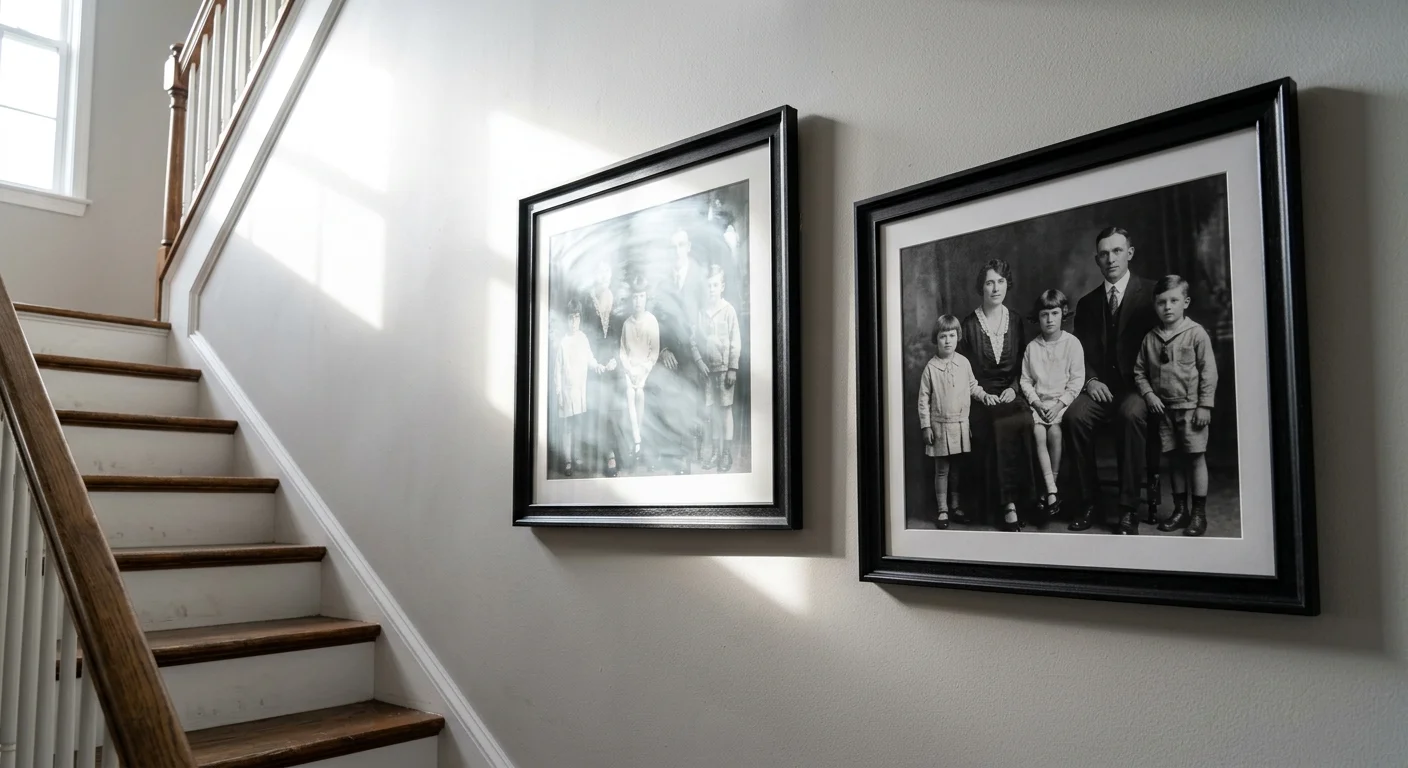
Optical Clarity and Sightlines: Eliminating Glare from Two-Story Windows
Staircases create unique viewing challenges because your viewing angle changes constantly as you ascend or descend the risers. Standard framed artwork hung along a level hallway receives viewing rays roughly perpendicular to the frame face.
On a 35-degree staircase rake, however, you view frames from steep diagonals below and above. High-mounted south-facing windows reflect directly across the face of framed images at these exact raking angles.
Traditional non-glare glazing utilizes an acid-etched or mechanically matte surface to break up specular reflections. This etching scatters incoming photons randomly across the exterior plane.
Unfortunately, that surface diffusion causes severe image degradation. When you stand more than two feet away or view the frame from a dynamic diagonal, etched glass diffuses the image into a murky blur.
Acid-etched non-glare glass creates optical haze by scattering reflected light. Optically coated anti-reflective glazing preserves deep shadows and paper grain by canceling reflections through wave interference.
Optium Acrylic and Museum Glass achieve optical clarity without surface etching. By holding reflections under 1.6%, both products allow you to inspect heirloom portraiture clearly from any step on the staircase.
Tru Vue Museum Glass produces a faint, subtle blue or violet residual reflection under specific hard light angles. Optium Acrylic yields a slightly softer, extremely pale green-blue residual tint that tends to blend better into sunlit architectural spaces.
If direct rays from a double-height window strike glass at an angle steeper than 60 degrees, minor specular bounce remains inevitable. Positioning frames staggered along your stair stringers helps keep those bright solar reflection paths out of normal eye-level sightlines.
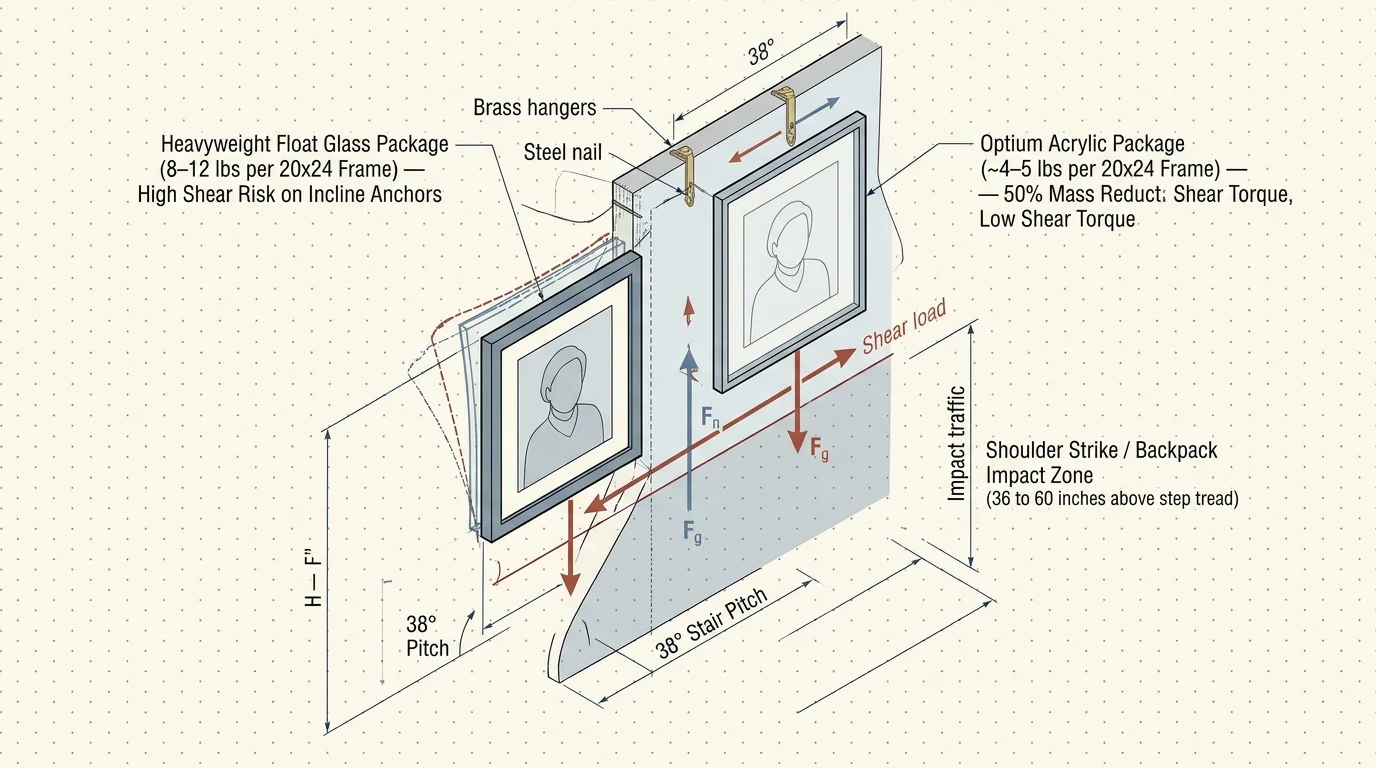
Weight Loads and Impact Physics: Protecting Prints on High-Traffic Incline Walls
Staircases are narrow, high-hazard transit paths. People frequently lose balance, children grip wall lines, and moving bulky furniture upstairs carries substantial risk of accidental collisions.
Standard float glass and Tru Vue Museum Glass are brittle inorganic silicate sheets. When impacted by a solid object, glass fractures into razor-sharp shards that drop directly downward within the frame envelope.
These jagged falling shards slice through antique photograph paper fibers and scrape emulsion away from fiber-based paper cores. In severe impacts, the glass shatters outward across the stair treads, creating safety risks for family members.
Tru Vue Optium Acrylic offers 10 to 17 times the impact resistance of float glass. When subjected to severe blunt-force trauma, the acrylic flexes, absorbing kinetic energy without splintering into loose, destructive fragments.
Weight is another crucial structural factor along inclined staircase framing lines. A 3.0-millimeter sheet of Museum Glass weighs approximately 1.45 pounds per square foot, whereas Optium Acrylic weighs only 0.70 pounds per square foot.
Consider a large 24-by-36-inch framed portrait. The glass sheet alone adds 8.7 pounds to the overall weight of the frame, mat, backing, and mounting system.
Gypsum board on stairwells often spans tall open spaces without continuous interior stud support directly behind your desired hanging layout. Standard hanging wires hung from single nails will shift downward along the wall slope over time.
Optium Acrylic cuts glazing dead-load by 50%. This lower weight reduces shear force stress on drywall toggle bolts and heavy-duty aluminum Z-bar cleats installed along the diagonal staircase incline.
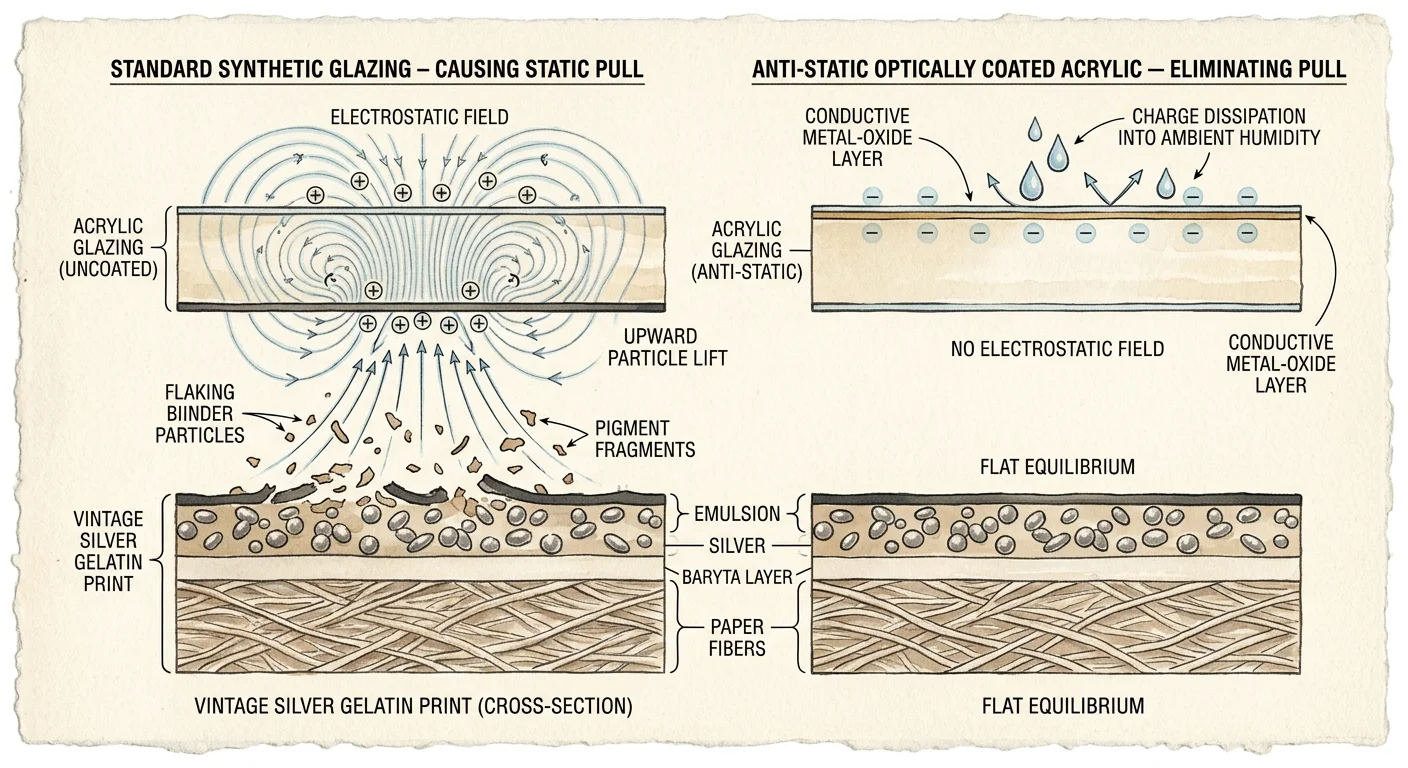
Static Charges and Fragile Emulsions: The Hidden Threat to Vintage Media
Standard extruded or cast acrylic glazing carries a severe functional defect: high electrostatic charge retention. Wiping standard acrylic with a dry microfiber cloth generates thousands of volts of static charge across its surface.
This static field pulls loose particles toward the interior face of the glazing. Worse, it exerts strong physical suction directly on the surface of your artwork.
Vintage photographs frequently suffer from microscopic emulsion lifting, brittle gelatin cracking, or friable retouching media. Crayon enlargements, pastel portraits, and charcoal-tinted solar prints from the late nineteenth century are exceptionally vulnerable to electrostatic pull.
Standard acrylic can lift these unbonded photographic pigments straight off their paper mounts. The lifted particles adhere permanently to the inside surface of the acrylic, permanently ruining your historic print.
Tru Vue Optium Museum Acrylic solves this problem with a permanent, vapor-deposited anti-static coating. Its surface electrical resistivity measures below 1.0E+12 Ohms per square, meeting rigid conservation standards outlined by the American Institute for Conservation.
This anti-static layer dissipates static charges instantly, making it just as inert as natural silicate glass. You can safely clean Optium Acrylic without turning your frame interior into an electrostatic particulate magnet.
Regardless of whether you choose Museum Glass or Optium Acrylic, you must never allow glazing to touch your photographic print directly. Condensation cycles on sunlit exterior walls will cause the gelatin emulsion to soften and weld permanently to the glazing.
Always insert a 4-ply or 8-ply 100% cotton rag mat board or inert archival acrylic spacers between print and glazing. This gap provides air circulation and protects fragile print surfaces from direct thermal conduction.

Worked Framing Financials: Cost-per-Square-Inch Breakdown for a Gallery Wall
Upgrading to conservation glazing represents a noticeable investment. To budget your staircase gallery properly, calculate your required material using precise cost-per-square-inch math rather than rough frame estimates.
Standard picture framing glass costs approximately $0.05 to $0.08 per square inch cut to size. Tru Vue Museum Glass averages $0.22 to $0.28 per square inch, while Tru Vue Optium Museum Acrylic ranges from $0.65 to $0.85 per square inch.
Here is a worked example for an eight-frame gallery wall along a south-facing staircase. The installation includes four 11×14-inch portraits and four 16×20-inch portraits.
First, calculate the square inches for the smaller frames: 11 inches multiplied by 14 inches equals 154 square inches per frame. Four frames yield 616 square inches total.
Next, calculate the larger frames: 16 inches multiplied by 20 inches equals 320 square inches per frame. Four frames yield 1,280 square inches total.
Summing the two sets results in 1,896 total square inches of glazing area across the eight family portraits. This equals 13.17 square feet of material.
At an average rate of $0.24 per square inch, glazing this layout with Tru Vue Museum Glass costs $455.04. The total glass weight across the eight frames equals roughly 19.1 pounds.
At an average rate of $0.72 per square inch, glazing this layout with Tru Vue Optium Acrylic costs $1,365.12. The total acrylic weight across the eight frames drops to roughly 9.2 pounds.
The price difference between the two choices is $910.08 for this eight-frame gallery. You must determine if that premium balances the benefits of shatter resistance, 50% lighter wall loads, and superior handling safety on your stairs.
If budget constraints require compromise, adopt a hybrid installation plan. Glaze larger frames exceeding 16×20 inches in Optium Acrylic to eliminate dangerous glass weight, and use Museum Glass on smaller frames mounted securely out of reach.
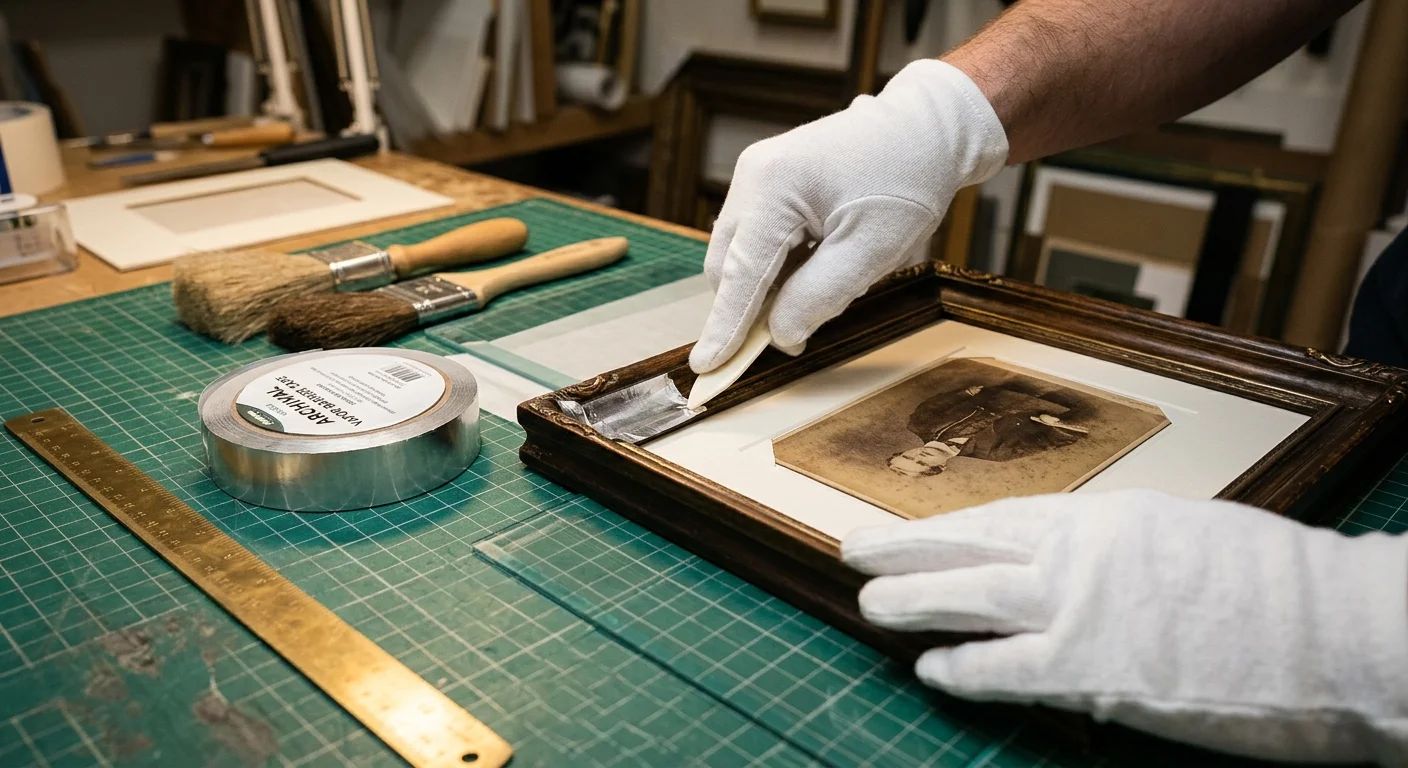
Archival Mounting Protocols: Sealing and Securing Historic Photo Media
Even the finest UV-blocking glazing fails if atmospheric pollutants and fluctuating humidity degrade the frame from behind. South-facing stairwells experience massive diurnal temperature swings as the sun moves across two-story glass.
These temperature swings cause air inside unsealed frames to expand during the day and contract at night. This breathing cycle draws in ambient humidity, pollen, cooking oils, and airborne particulate pollution.
To guard against this degradation, seal the perimeter of the glazing, mat, and backing board into a unified archival package. Use an aluminized barrier tape, such as Lineco Archival Frame Sealing Tape, wrapped around the outer edges of the stack.
Never mount original family photographs with pressure-sensitive adhesives, masking tape, or dry-mount tissue. These commercial products release acidic degradation compounds and cross-link irreversibly with paper fibers, causing yellow staining.
Mount historic photographs using reversible archival hinges fashioned from Japanese mulberry paper adhered with purified wheat starch paste. Alternatively, secure prints using archival polyester or archival polypropylene mounting corners that hold prints mechanically without adhesive contact.
For detailed procedures on safe, reversible mounting configurations, consult the preservation guidelines maintained by the Library of Congress Preservation Directorate. These methods ensure you can remove irreplaceable original photographs undamaged in the future.
For structural hanging along the staircase rake, abandon traditional braided wire strung across two screw eyes. On an incline, frames hung on wire slide off balance whenever footsteps or heavy doors vibrate the wall.
Instead, install interlocking extruded aluminum French cleats or Z-bars directly into wall studs. Align each cleat precisely with a digital laser level set to your staircase’s specific angle of incline to lock every portrait firmly in place.
Frequently Asked Questions
Does 99% UV museum glass stop family photographs from fading completely?
No. While 99% UV glazing blocks the most damaging chemical wavelengths, visible light also causes fading through photo-oxidation. You must control ambient lux levels and draw blinds during intense afternoon sun to protect vulnerable prints.
Can I clean Tru Vue Museum Glass and Optium Acrylic with standard window cleaner?
Never use standard ammonia-based glass cleaners on archival glazing. Ammonia damages the delicate anti-reflective optical coatings on Museum Glass and ruins acrylic surfaces; clean both with an ammonia-free cleaner and clean microfiber towels.
How do I test if my existing staircase frame has UV-filtering glazing?
You can check your glazing by shining a handheld 365-nanometer blacklight torch through the glass onto a white piece of printer paper. If the paper fluoresces bright blue-white, the glazing does not block UV light.
Is museum glass heavy enough to damage drywall along a staircase?
On small frames, glass weight is manageable with standard drywall anchors. For frames larger than 18 by 24 inches, glass weight creates substantial shear load, making lightweight archival acrylic or stud-anchored cleat mounts a much safer choice.
Disclaimer: This article is for informational purposes only. When handling valuable or irreplaceable photographs, consider consulting a professional conservator. Always test preservation methods on non-valuable items first.