You risk destroying a 1944 military portrait if you frame it flush against original service medals. Standard shadow box displays inadvertently create sealed chemical chambers where off-gassing fabrics, degrading alloys, and frame finishes tarnish vintage gelatin silver emulsions.
Most DIY guides advise pinning or gluing artifacts together onto decorative felt backing. In contrast, true archival preservation requires you to isolate the photograph chemically and physically using an inert sink mat and polyester micro-barriers.
By isolating these components within a shared frame, you eliminate cross-contamination while honoring your veteran’s military service. Here is the exact fabrication process to build a conservation-grade display from scratch.
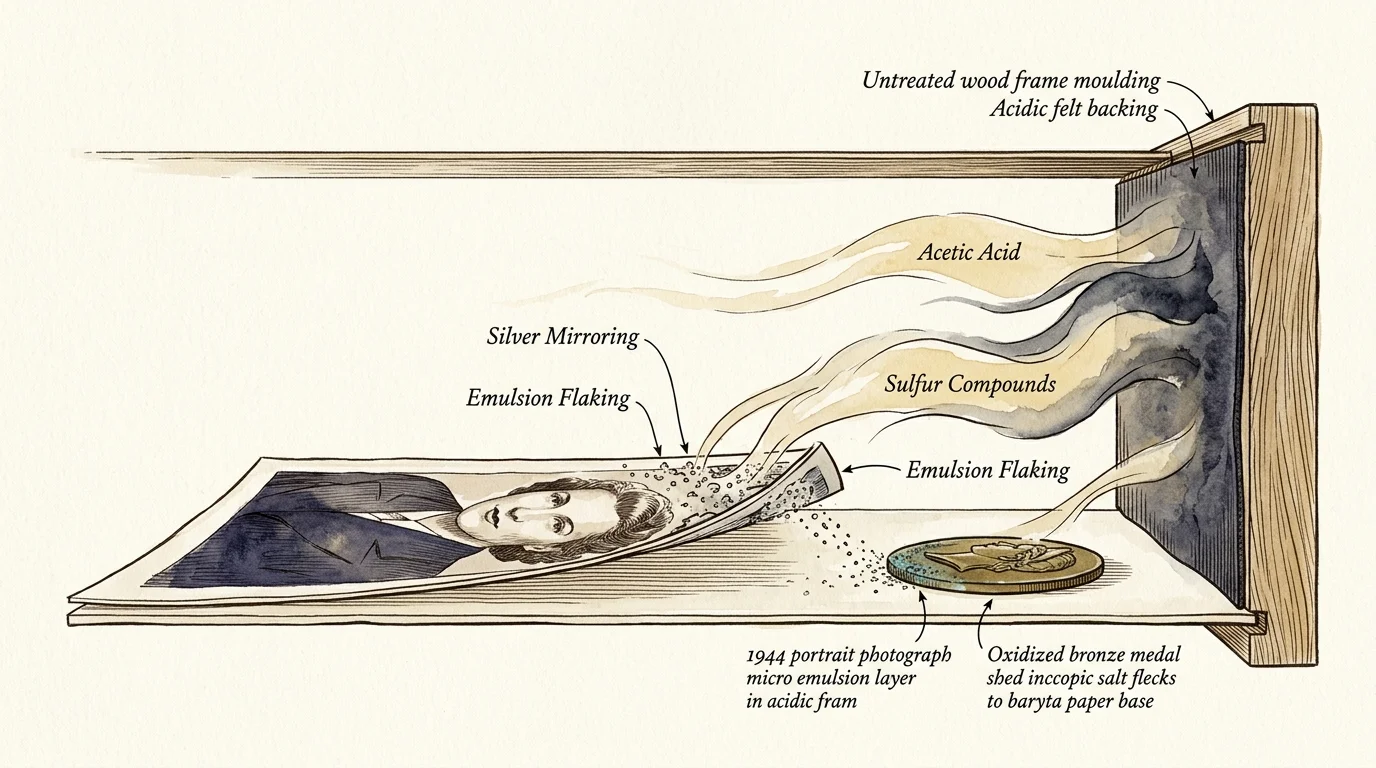
The Microclimate Danger: Chemical Cross-Contamination in Enclosed Displays
Shadow boxes house deeper air pockets than conventional picture frames; consequently, they create stagnant microclimates. Trapped atmospheric contaminants concentrate over time rather than dissipating into the surrounding room.
A typical 1944 portrait relies on a gelatin silver develop-out emulsion coated over a baryta layer. During World War II, paper mills faced extreme wartime material shortages, which often yielded photographic base papers containing residual processing chemicals.
When you place vintage military medals alongside these prints, you introduce volatile organic compounds and active metals. Wool and silk ribbon fabrics from the 1940s naturally release sulfur compounds as their protein fibers age and break down.
Airborne sulfur reacts rapidly with delicate photographic silver particles, causing irreversible silver mirroring, yellowing, and optical density loss. Research from the Image Permanence Institute confirms that reduced sulfur gases trigger catastrophic redox blemishes on unprotected gelatin silver emulsions.
Bronze, copper, and zinc medal pendants generate secondary hazards. When ambient humidity fluctuates, these non-ferrous metals corrode and shed micro-crystalline salts directly into the enclosure.
The enclosed atmosphere of an unsealed shadow box behaves as an accelerated aging chamber, concentrating acidic off-gassing directly against vulnerable silver image layers.
Commercial shadow boxes constructed from solid oak, pine, or medium-density fiberboard (MDF) compound this threat. These wood products steadily emit acetic acid and formaldehyde, accelerating paper embrittlement and emulsion flaking.
Standard craft felt backing adds another contamination source because commercial textile dyes contain sulfur-bearing mordants. To protect your veteran’s irreplaceable print, you must separate its atmospheric housing from these metallic and fibrous contaminants.
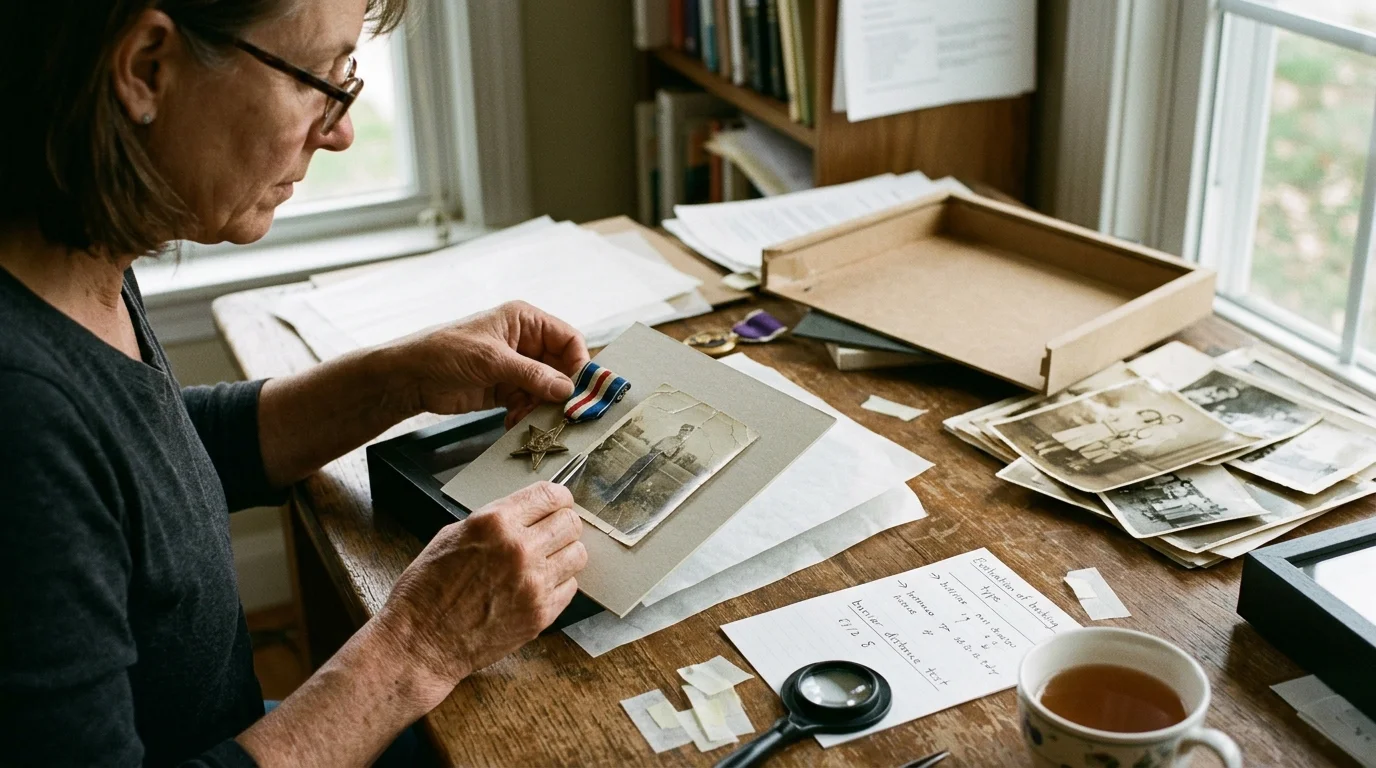
Evaluating Archival Barriers and Mounting Substrates
You cannot use standard framing supplies from hobby shops for this assembly. You must select mounting boards and barrier membranes manufactured specifically to pass the Photographic Activity Test (ISO 18916).
Standard mat boards made from wood pulp contain lignin, an organic polymer that degrades into acid over time. For photo preservation, you require 100% cotton rag boards with a stable alkaline buffer of 2% calcium carbonate.
Medal mounts, however, require unbuffered substrates because alkaline environments accelerate the corrosion of protein-based silk ribbons. You must manage this material conflict by choosing distinct boards for each artifact zone.
| Substrate / Barrier Material | Thickness & Composition | Primary Functional Role | Chemical Resistance Rating | Estimated Cost (USD) |
|---|---|---|---|---|
| Melinex 516 (Inert Polyester) | 3 mil biaxially oriented PET film | Vapor and contact barrier for photo face | Inert; impervious to sulfur and organic acids | $24.50 (per 10-pack 11×14 sheets) |
| Marvelseal 360 | 5 mil nylon/aluminum/polyethylene laminate | Hermetic vapor seal on raw frame wood | Complete barrier against wood-derived VOCs | $38.00 (per 10-foot roll) |
| Rising Museum Board | 4-ply 100% cotton, buffered (pH 8.5) | Structural sink mat and window for photo | Resists acid migration; passes ISO 18916 PAT | $16.75 (per 32×40 board) |
| Alpharag Artcare MicroChamber | 4-ply 100% cotton with molecular sieves | Backing substrate for medal mounting area | Active adsorption of airborne pollutants | $29.50 (per 32×40 board) |
| Lineco Archival Linen Tape | 5.5 mil high-thread unbleached linen | Hinging mat boards and outer barriers | Water-activated neutral dextrin adhesive | $19.25 (per 1-inch x 30-foot roll) |
Biaxially oriented polyethylene terephthalate (PET), known commercially as Melinex 516, provides the ideal clear barrier. It does not contain plasticizers, slip agents, or residual surface coatings that could transfer to the print.
For sealing the interior wooden walls of the frame, Marvelseal 360 provides an impenetrable foil layer. This prevents wood acids from entering the framing airspace over decades of continuous display.
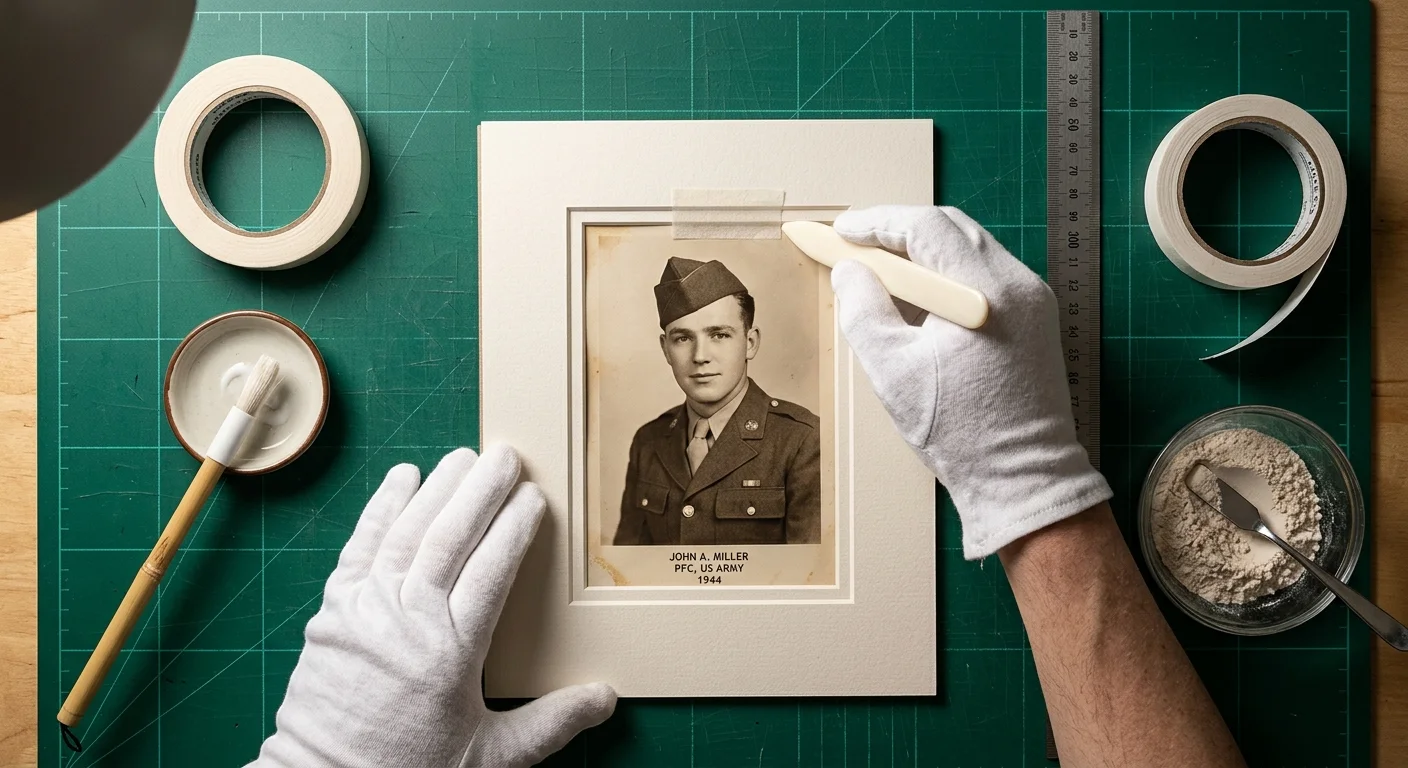
Isolating the 1944 Portrait with a Custom Sink Mat
A sink mat forms a protective well that holds your vintage snapshot securely without applying surface pressure. This recess prevents the print emulsion from contacting the display glass or wandering into the medal section.
Begin by cutting an 8-ply or double-layered 4-ply cotton rag backing board to your enclosure dimensions. This base layer provides the rigid foundation for the entire housing assembly.
Measure your 1944 snapshot accurately with an archival metal ruler to the nearest millimeter. Cut spacer strips from 4-ply museum board to frame the snapshot’s perimeter, leaving an expansion margin of 1.5 millimeters on every side.
Adhere these spacing strips to your base board using Lineco acid-free water-activated linen tape. Never use pressure-sensitive masking tapes, rubber cement, or spray adhesives near historical photographic emulsions.
Secure the photograph inside this recess using conservation-grade polyester mounting corners. These Melinex corners hold the print via friction and geometry rather than direct adhesive contact with the paper fibers.
Cut a 4-ply buffered museum rag mat to serve as the visual window over the portrait sink. The window opening should overlap the edges of your photo by exactly 3 millimeters to conceal the clear polyester corners.
Cut a sheet of 3 mil Melinex 516 film to match the exact exterior dimensions of your sink mat assembly. Place this transparent film directly over the sink mat window, then seal its edges using 1-inch archival barrier tape.
This sealed construction creates an isolated, self-contained micro-environment for the 1944 portrait. Pollutants migrating from aged medal ribbons in the adjacent chamber cannot penetrate this sealed polyester chamber.
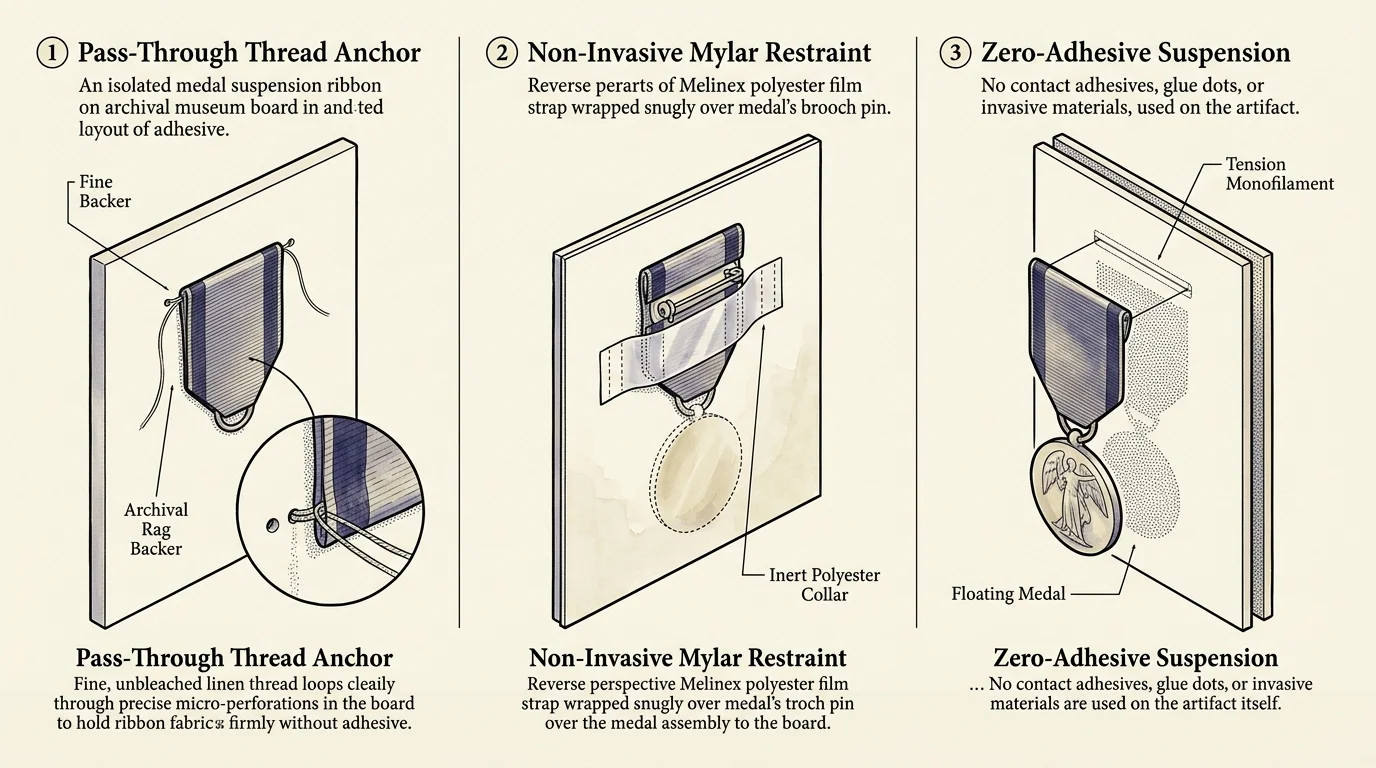
Non-Adhesive Mechanical Mounting for Ribbons and Medals
Medals and ribbon bars must remain fully removable and completely undamaged by your mounting technique. Applying hot glue, epoxy, or double-sided carpet tape to military ribbons ruins their historical and collector value permanently.
Mount all insignia to a separate, unbuffered 4-ply archival board positioned adjacent to your sealed photo compartment. Unbuffered board prevents alkaline hydrolysis of the original rayon, wool, or silk medal drapes.
Position your veteran’s medal pendants on the board surface, maintaining uniform spacing between honors according to official military precedence. Mark tiny pinhole references above and below the ribbon drape using an archival micro-spatula or piercing awl.
Thread an unbleached 100% cotton button-hole thread or inert polyester monofilament through a curved surgical needle. Pass the thread from the back of the board, over the suspension ribbon at the brooch bar, and back down through the board.
Fasten the threads securely on the reverse side of the board with a surgeon’s square knot. Cushion the reverse knots with small squares of archival acid-free blotter paper to prevent point-load pressure depressions.
If the medals retain their original pin-back brooches, insert the pin shaft directly into micro-slits cut into the museum board. Secure the sharp pin catch on the back using an inert polyethylene foam stop block.
For ribbon bars with clutching posts, drill 2-millimeter holes through the mounting board corresponding to the post positions. Push the brass posts through the holes and lock them using archival silicone clutch retainers rather than tarnished metal damas.
Never polish medals or apply chemical dips prior to mounting. Cleaning compounds leave corrosive residues within the ribbon weave that outgas violently inside display cases.
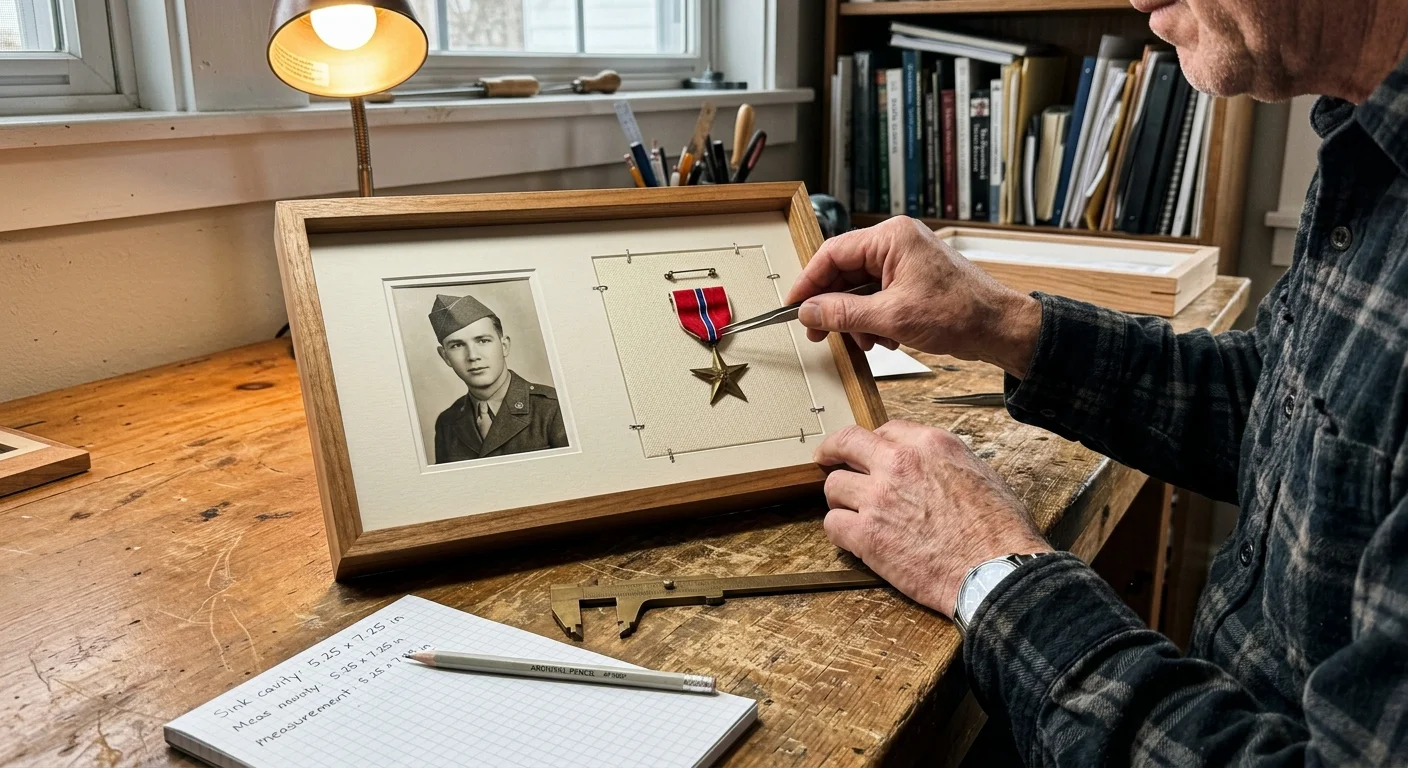
Worked Example: WWII Bronze Star and Portrait Assembly
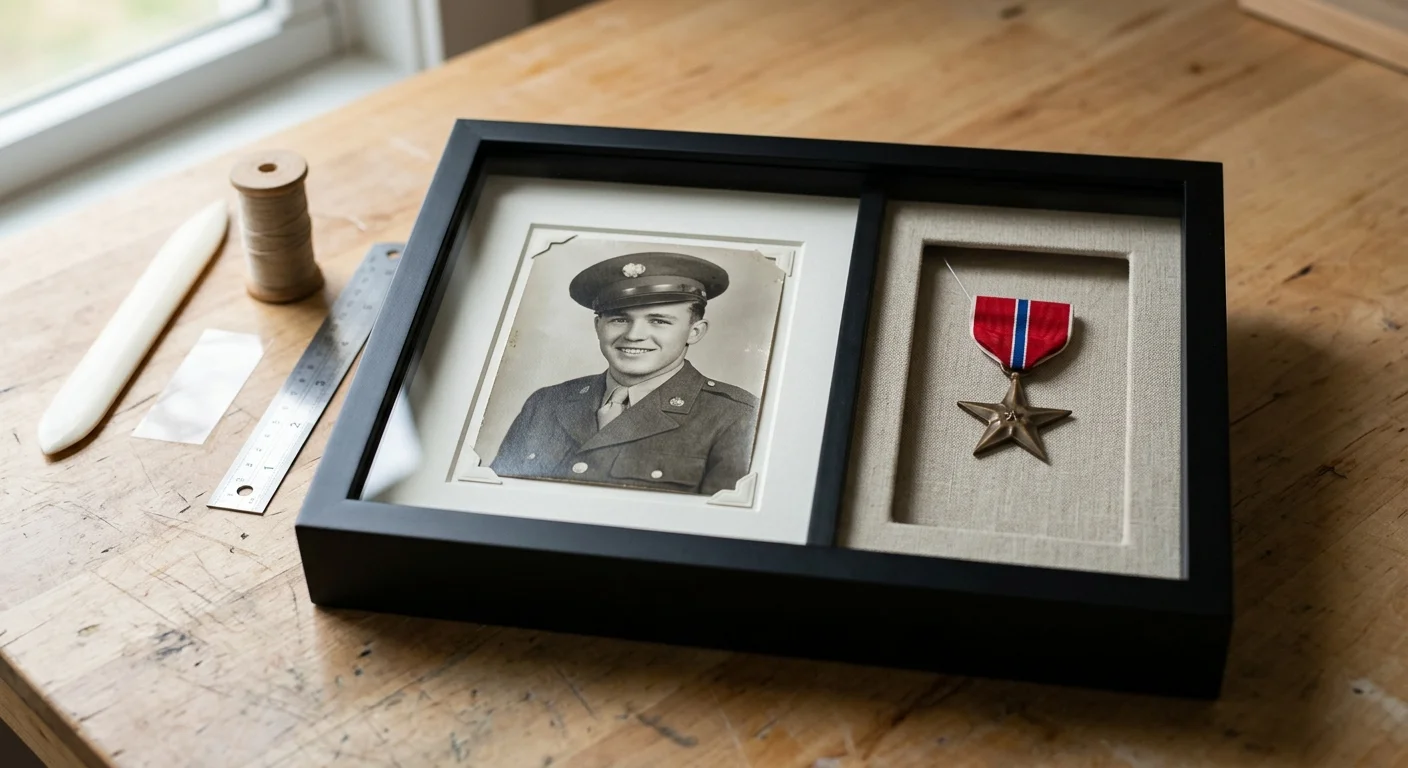
To demonstrate this construction method, consider a real-world assembly designed for a veteran’s wartime honors. This scenario houses an original 1944 portrait alongside an original Bronze Star, a Good Conduct Medal, and a three-ribbon bar.
The total display housing utilizes an 11-inch by 14-inch shadow box with a usable interior depth of 1.25 inches. The total retail cost for raw conservation supplies for this build runs to $84.20.
Your portrait measures 4.0 inches wide by 6.0 inches high, featuring moderate silver mirroring along the right margin. The Bronze Star drape measures 1.375 inches wide by 2.75 inches long from brooch to pendant tip.
Allocate the left 5.5 inches of the frame width to the sealed photograph enclosure. Reserve the remaining 5.5 inches of width for the medal display, separated by a 0.25-inch cotton-board structural partition.
First, build the photo sink mat using two layers of 4-ply Rising Museum Board measuring 5.25 inches by 13.0 inches. Cut the interior pocket to 4.125 inches by 6.125 inches, providing the necessary expansion gap for humidity cycles.
Mount the 1944 portrait within the pocket using four Lineco 1.25-inch archival polyester corners. Apply the 3 mil Melinex 516 protective cover sheet over this mat section and seal the edges with barrier tape.
Second, prepare the medal substrate using unbuffered 4-ply cotton board cut to 5.25 inches by 13.0 inches. Mark suspension anchor points at 2.5 inches and 6.0 inches from the top border for the medal hangings.
Pierce four micro-openings for each medal using a size-00 bookbinding awl. Loop Gütermann unbleached polyester thread through the ribbon folds behind the top brooch and anchor the thread on the reverse side.
The entire cutting, mounting, and sealing process requires approximately 135 minutes of hands-on work. The result is a dual-compartment display system that eliminates cross-contamination while presenting an integrated visual tribute.
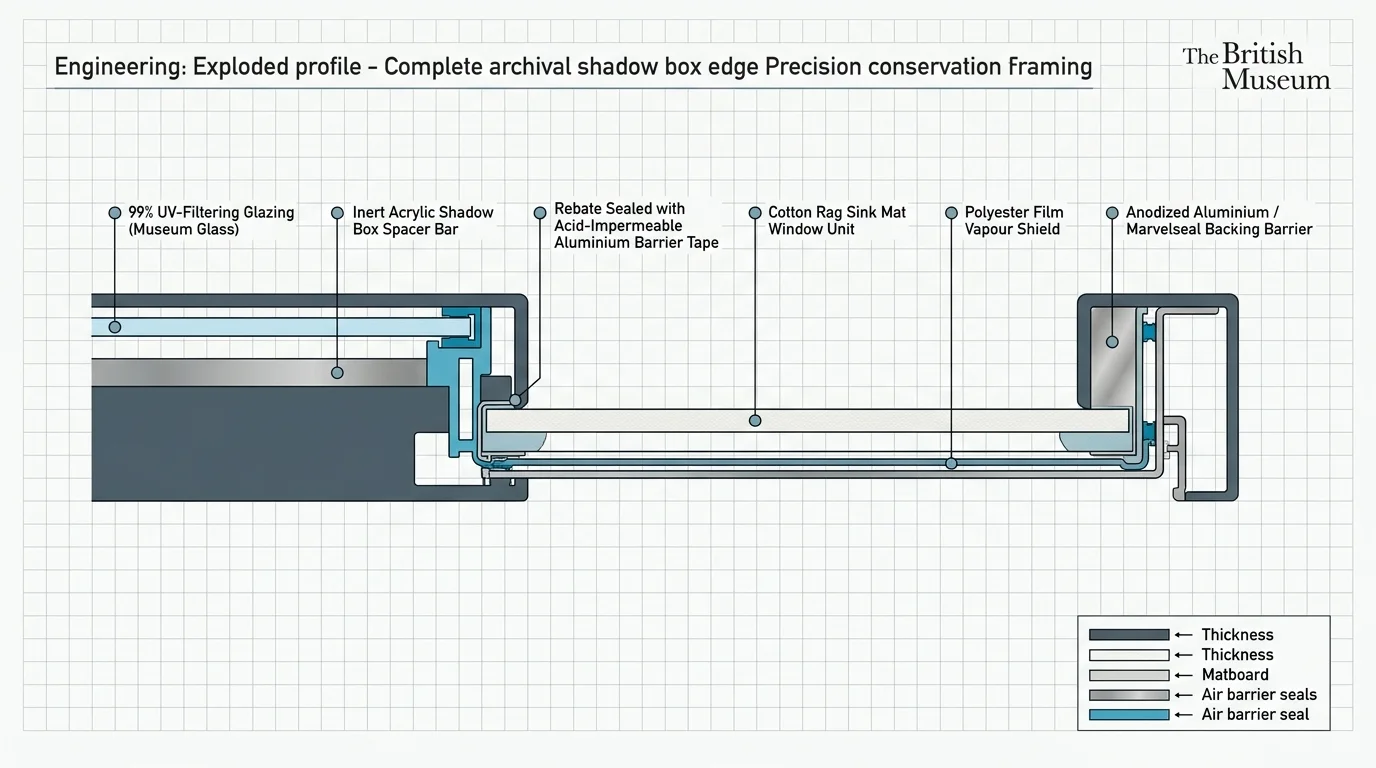
Sealing Frame Chemistry and Glazing Selection
Wood frames continuously release volatile organic acids that compromise both emulsions and metals over long storage periods. Guidelines published by the National Archives Preservation office stress that wooden enclosures require inert vapor-barrier linings before housing sensitive records.
Cut strips of Marvelseal 360 laminate to match the depth of the interior shadow box rabbet walls. Press the foil strips into the frame rabbet using a bone folder, with the heat-sealable polyethylene side facing the wood.
Bond the Marvelseal to the wood using a specialized tacking iron set to 275°F (135°C). Ensure complete coverage over all raw wood, joints, and side walls, leaving no exposed timber within the frame chamber.
Cover the visible face of the aluminum barrier lining with archival 4-ply rag mat strips to preserve visual aesthetics. Fasten these decorative wall mats with Lineco neutral pH PVA adhesive applied sparingly with a micro-roller.
Glazing selection impacts the longevity of the enclosed portrait just as heavily as chemical isolation. Standard clear float glass permits up to 55% of harmful ultraviolet radiation (300 to 380 nanometers) to penetrate the frame.
Select Tru-Vue Optium Museum Acrylic or 99% UV-blocking Conservation Clear float glass. Museum acrylic provides anti-reflective coatings while filtering out 99% of damaging UV light waves that trigger emulsion yellowing.
Acrylic also provides ten times the impact resistance of conventional picture glass, protecting your family heirlooms from accidental shattering. Ensure the glazing rests on an archival spacer so it never touches either the photo enclosure or the medals.
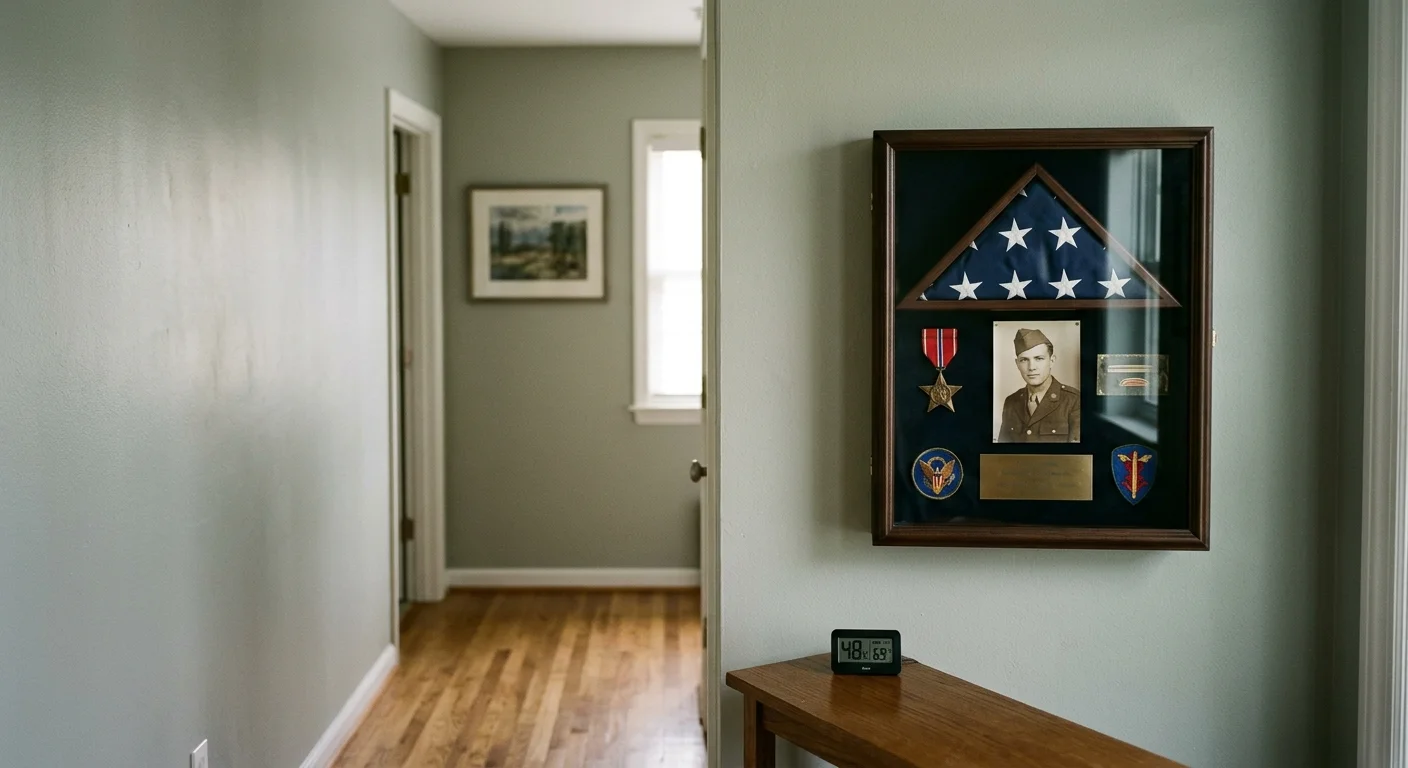
Preventative Display and Environmental Maintenance
Once you finish assembling your archival shadow box, you must select an appropriate display environment within your home. Never hang an archival display along an exterior wall, where severe thermal gradients drive interior condensation cycles.
Avoid rooms with high ambient humidity or temperature spikes, such as kitchens, bathrooms, or uninsulated hallways. Maintain a stable indoor environment with temperatures between 65°F and 70°F (18°C to 21°C) and relative humidity between 30% and 45%.
Keep the display away from direct sunlight and radiant heat sources like baseboard heaters or fireplace flues. Illumination levels should remain under 50 lux of indirect, UV-free LED lighting to prevent premature fading of fragile medal ribbons.
Conduct an inspection of your shadow box display every twelve months to monitor material stability. Look for signs of silver mirroring expansion on the photo or blue-green verdigris powder forming on bronze medal clasps.
Check the mechanical threads securing your medal drapes to ensure continuous tension without fiber sagging. If you notice interior clouding on the glazing, open the frame immediately to replace the barrier seals and check for moisture intrusion.
Document the identity, service branch, and dates of the veteran on an acid-free index card attached to the exterior backing. Use an archival pigment pen like a Sakura Pigma Micron to guarantee this crucial family history endures alongside the physical artifacts.
Frequently Asked Questions
Can I clean oxidized military medals with metal polish before mounting them?
No, you should never use commercial chemical polishes or brass cleaners on historical military honors. Polishing compounds strip original patinas, degrade underlying strike details, and leave chemical residues that off-gas and destroy nearby photographic silver.
Why is standard craft foam core unsafe for a WWII medal shadow box?
Commercial foam core emits styrene vapors and acidic off-gassing as its polystyrene core and low-grade surface liners degrade. You must use 100% cotton rag board or specialized conservation boards containing molecular sieves that pass the Photographic Activity Test.
Can I use double-sided archival tape directly on the back of the 1944 portrait?
Never apply adhesives directly to the paper support of an original vintage snapshot, regardless of archival claims. Adhesives stain fiber bases permanently; instead, secure your print exclusively using reversible Melinex mounting corners or archival photo strips.
What is silver mirroring, and can this mounting method reverse it?
Silver mirroring appears as a shiny, metallic sheen on dark areas of a photograph caused by migrating oxidized silver particles. Archival mounting cannot reverse existing mirroring, but isolating the print behind a Melinex barrier prevents sulfur gases from worsening the degradation.
Disclaimer: This article is for informational purposes only. When handling valuable or irreplaceable photographs, consider consulting a professional conservator. Always test preservation methods on non-valuable items first.