
You can identify the exact era of unlabeled family prints without writing on the back. By cross-referencing automotive chrome trim, garment lapel widths, and residential siding exposure, you will narrow three decades of family history down to precise three-year windows.
Most guides rely on vague decade generalizations like “the fifties” or “pre-war.” This visual taxonomy gives family historians sorting thousands of undated mid-century snapshots a rigorous, repeatable protocol for cataloging prints accurately.
Physical clues in the background reveal the exact year a camera shutter clicked. Grab a 10x jeweler loupe and your unsorted archive boxes to begin decoding each print.
The Triangulation Method: Cars, Lapels, and Architectural Cladding
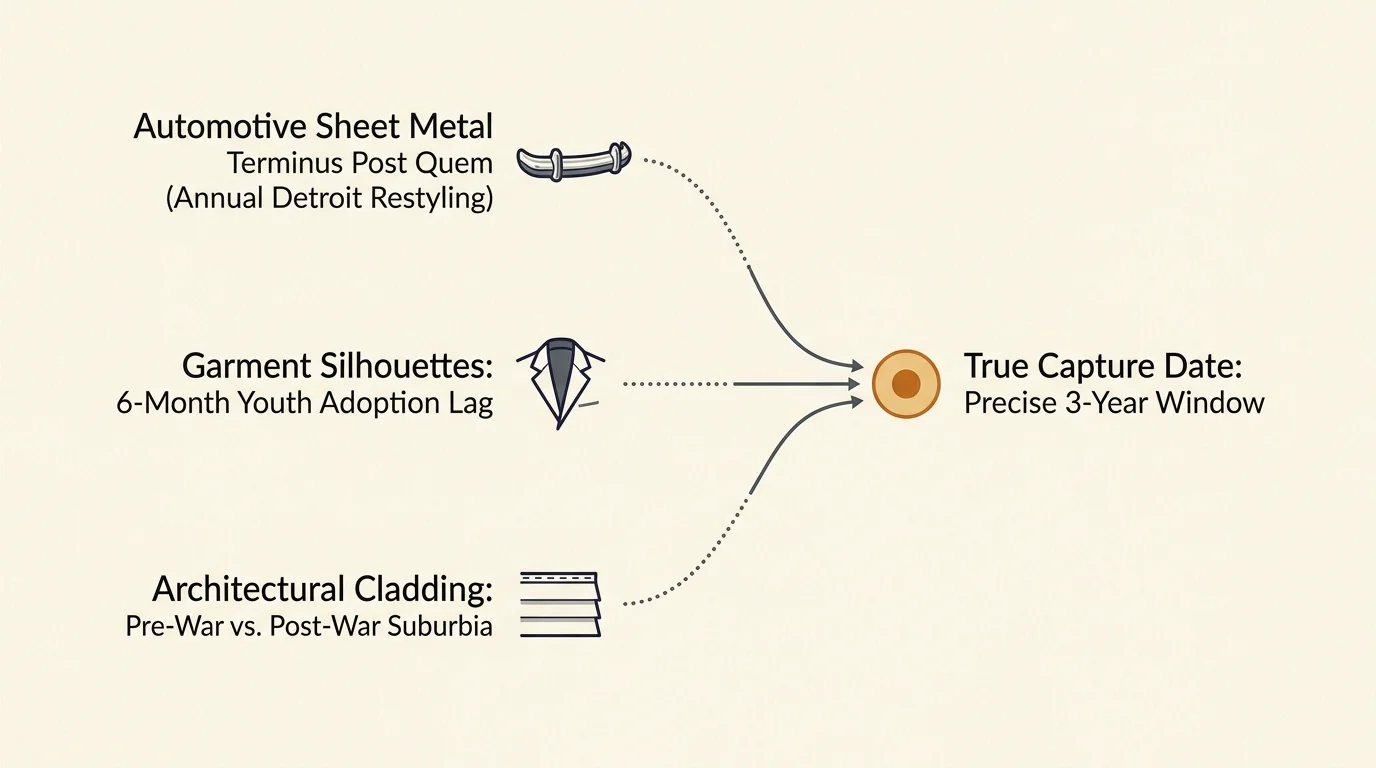
Dating vintage photographs requires forensic observation rather than casual guesswork. When you inspect an undated snapshot, you must evaluate three distinct data streams simultaneously.
Historians call the earliest possible moment an event could occur the terminus post quem. Manufactured goods provide your firmest chronological anchors because factory release dates are historical facts.
Automobiles serve as primary anchors because Detroit restyled body lines every twelve months. A front bumper guard or chrome side sweep instantly establishes the earliest year the shutter clicked.
Clothing provides your secondary verification stream. While older adults often wore out-of-style garments, teenagers and young mothers adopted mass-market fashion trends within six months of commercial release.
Architectural exterior finishes supply the tertiary anchor. Siding profiles, replacement windows, and television aerials establish whether a photograph depicts pre-war construction or post-war suburban development.
An automobile establishes the hard boundary of the past; you cannot photograph an object before its assembly line finishes production.
Relying on a single feature invites dating errors. An eccentric uncle driving a ten-year-old roadster in 1948 will deceive you if you only inspect the vehicle.
By triangulating automotive sheet metal against garment silhouettes and residential siding exposure, you eliminate lag anomalies. This method consistently compresses broad decade estimates into actionable three-year windows.
Automotive Chronology: Chrome, Grilles, and Tail Fins (1920–1960)
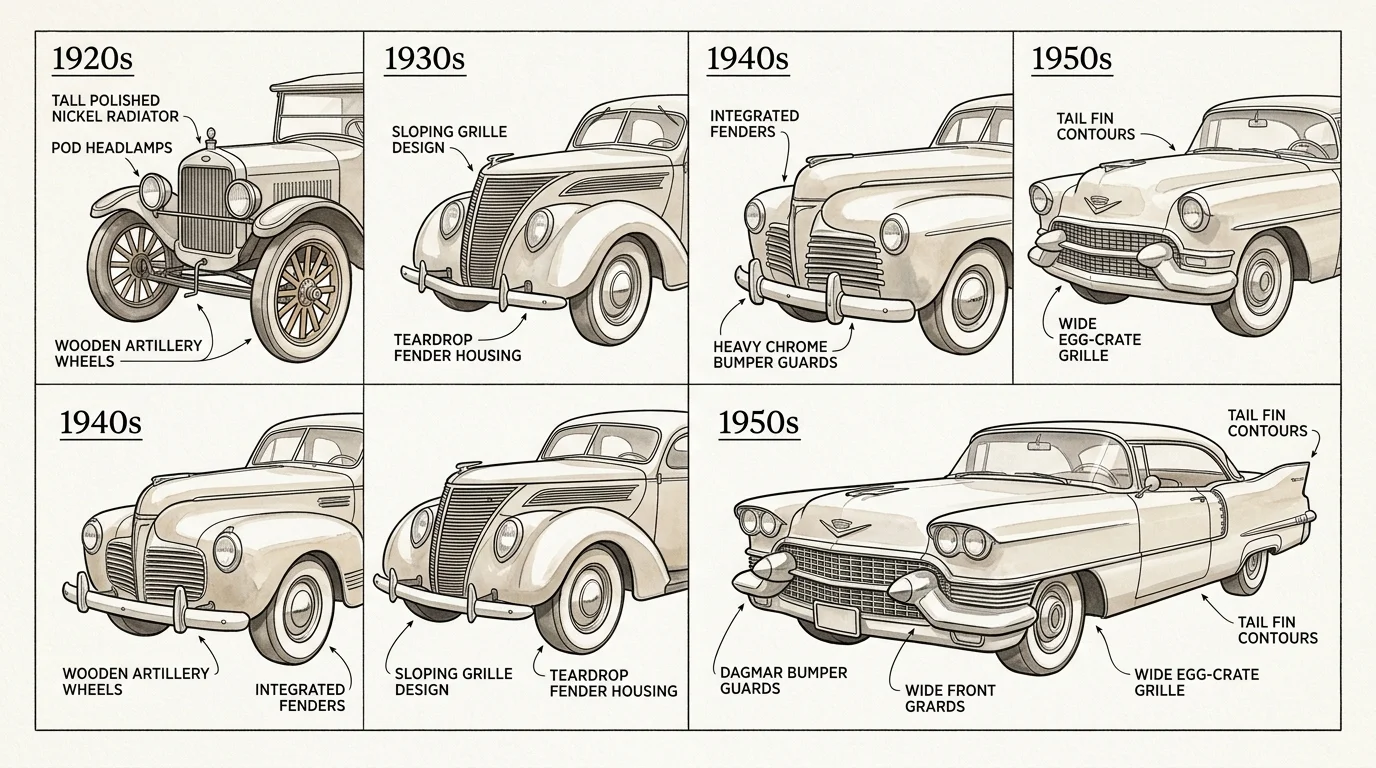
You can date old family photos by cars parked in driveways and streetscapes. American manufacturers altered automotive sheet metal constantly, leaving distinct chronological signatures across four decades.
During the 1920s, passenger vehicles carried tall, vertical radiator shells finished in polished nickel or black enamel. Headlamps sat as freestanding cylindrical pods mounted directly to structural fender crossbars.
Look closely at wheel construction in 1920s snapshots. Twelve-spoke wooden artillery wheels dominated early prints, gradually yielding to pressed-steel disc and wire wheels after 1926.
Between 1930 and 1933, grilles tilted backward into subtle vee shapes. Manufacturers abandoned external sun visors over windshields, while chrome plating fully replaced polished nickel trim.
General Motors introduced the stamped all-steel “Turret Top” roof in 1935. This eliminated traditional central fabric roof inserts, producing a seamless, curved steel roofline that instantly rules out the 1920s.
By 1937, headlamps migrated into aerodynamic teardrop pods recessed directly into front fender crowns. Grilles widened dramatically, adopting horizontal cast-chrome louvers that sat low between the catwalks.
The 1940 model year introduced standardized 7-inch round sealed-beam headlamps. These glass units sat fully flush inside front fenders, surrounded by wide chrome bezel rings.
Civilian automobile production stopped completely in February 1942 due to World War II retooling. Vehicles manufactured in late 1941 and early 1942 feature painted “blackout” trim instead of decorative chrome.
Post-war production resumed in late 1945 using warmed-over 1942 tooling. True modern styling emerged in 1949 with “slab-sided” pontoon bodies that completely eliminated separate running boards.
Studebaker, Ford, and Hudson led this 1949 pontoon revolution with integrated front-to-rear body sides. Windshields remained split into two flat panes divided by a central vertical metal mullion.
One-piece curved windshields arrived on high-volume production cars between 1952 and 1953. Heavily chromed front grilles adopted bullet-shaped bumper projections, often called Dagmar guards after a popular television personality.
The monumental styling revolution arrived in the 1955 model year. General Motors and Chrysler introduced radical panoramic wraparound windshields featuring vertical A-pillars that hooked rearward at the cowl.
Tri-tone and two-tone paint jobs divided by sweeping stainless steel bodyside trim peaked between 1955 and 1957. Tail fins sprouted from rear quarter panels, growing progressively taller each autumn.
Dual headlamps became legal across all American states for the 1958 model year. If an automobile displays four distinct front headlights, you can guarantee the photograph dates to late 1957 or later.
Tail fins peaked in dramatic height in 1959, epitomized by Cadillac’s 42-inch rear fins and bullet taillights. By 1961, fins flattened outward into subtle horizontal blade designs.
Clothing Silhouettes: Hemlines, Lapel Widths, and Shoulder Pads
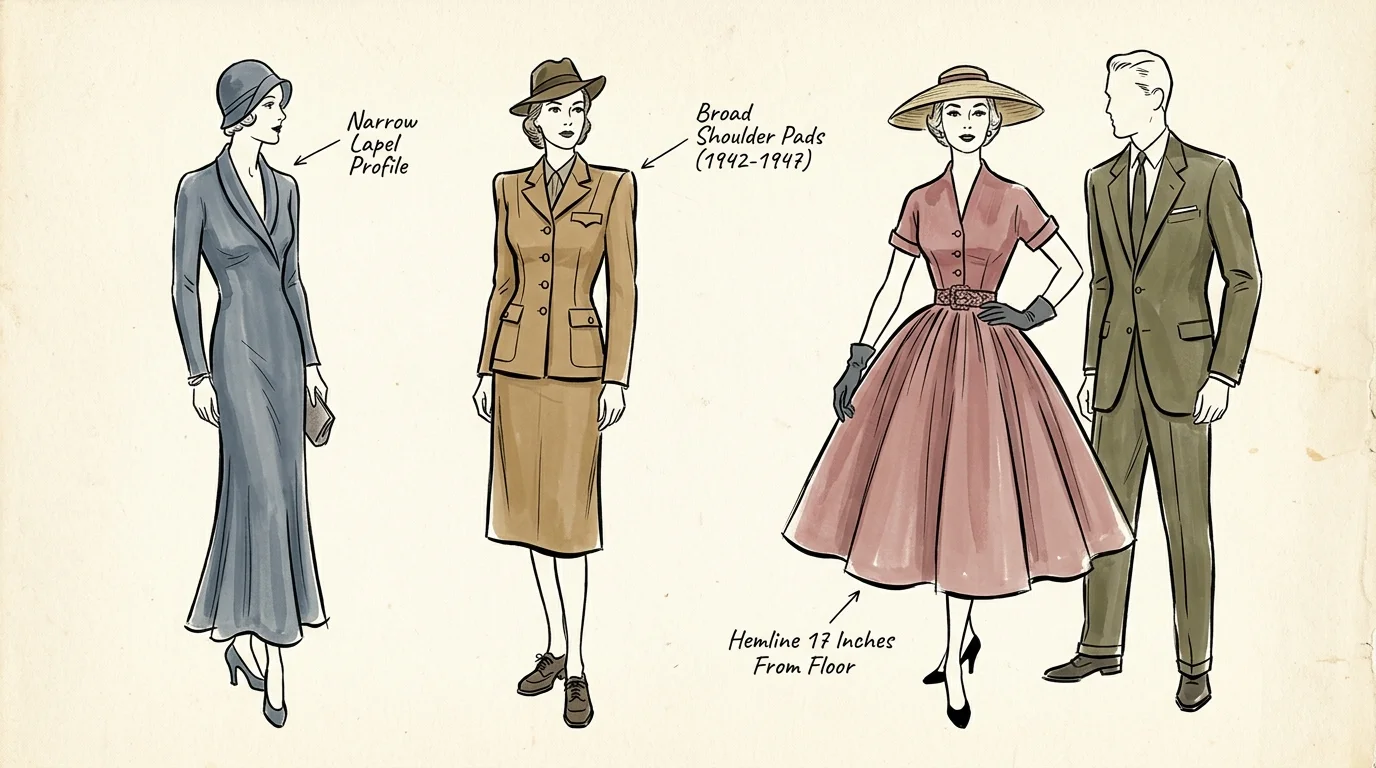
Constructing a timeline for unlabeled photos by fashion requires tracking silhouette volume rather than fabric colors. While print processing renders fabrics monochromatic, garment structure remains distinctly measurable.
The 1920s silhouette favored a tubular, androgynous profile with suppressed bustlines and dropped waistlines. Dropped waistbands rested on the upper hips rather than the anatomical waist.
Contrary to popular belief, 1920s hemlines rose above the knee only briefly during 1926 and 1927. Hemlines dropped swiftly to mid-calf by 1929, accompanied by bell-shaped cloche hats covering women’s foreheads.
Men in the 1920s wore boxy sack suits featuring high four-button front stances and narrow trousers. By 1925, college men popularized “Oxford bags,” wide-leg trousers measuring up to 24 inches around the cuffs.
The 1930s restored natural feminine curves through intricate bias-cut construction. Fabric clung smoothly to hips, while hemlines hovered twelve inches above the floor for daywear.
Shoulders broadened gradually throughout the late 1930s using small internal sleeve-head pads. Men shifted toward double-breasted lounge suits featuring expansive, pointed peak lapels spanning across the chest.
World War II triggered strict fabric rationing under the United States War Production Board’s Order L-85. Between 1942 and 1945, federal law restricted garment yardage and banned unnecessary decorative folds.
Wartime skirts shrank to a rigid, knee-length pencil or subtle A-line cut. Garments featured exaggerated, square shoulder pads to create an austere, military-inspired silhouette with minimal cloth.
Federal restrictions banned cuffs on men’s trousers, eliminated pocket flaps, and mandated shorter suit jackets. Men wore narrow single-breasted coats with narrow notch lapels to conserve wool yardage.
Christian Dior shattered wartime austerity in February 1947 by launching the revolutionary “New Look.” This silhouette featured rounded shoulders, a sharply corseted wasp waist, and voluminous calf-length skirts.
American department stores adapted Dior’s New Look for mainstream ready-to-wear lines by late 1948. Women achieved this wide silhouette by layering multiple stiff nylon crinoline petticoats beneath full circle skirts.
Men’s fashion reacted after 1948 with the dramatic “Bold Look.” Suit jackets expanded with thick shoulder padding, paired with wide, 4-inch hand-painted neckties ending several inches above the waistband.
A sharp sartorial reversal occurred between 1953 and 1955 as men adopted the collegiate “Ivy League” silhouette. Suits lost their heavy padding, adopting three-button natural shoulders and narrow 2.5-inch lapels.
Neckties narrowed into slender 2-inch “skinny” ties featuring geometric horizontal stripes or muted dark rep weave. Trousers became flat-fronted and tapered, ending without break over leather penny loafers.
Women’s casual wear diversified rapidly during the mid-to-late 1950s. High-waisted cigarette pants, cropped pedal pushers, and twin-set cardigans buttoned down the back dominated informal backyard snapshots.
Look for pointed cat-eye eyeglass frames adorned with carved plastic rosettes or paste rhinestones. These distinctive frames date almost exclusively between 1953 and 1961.
Architectural Cladding and Yard Fixtures: Background Clues That Lock the Date
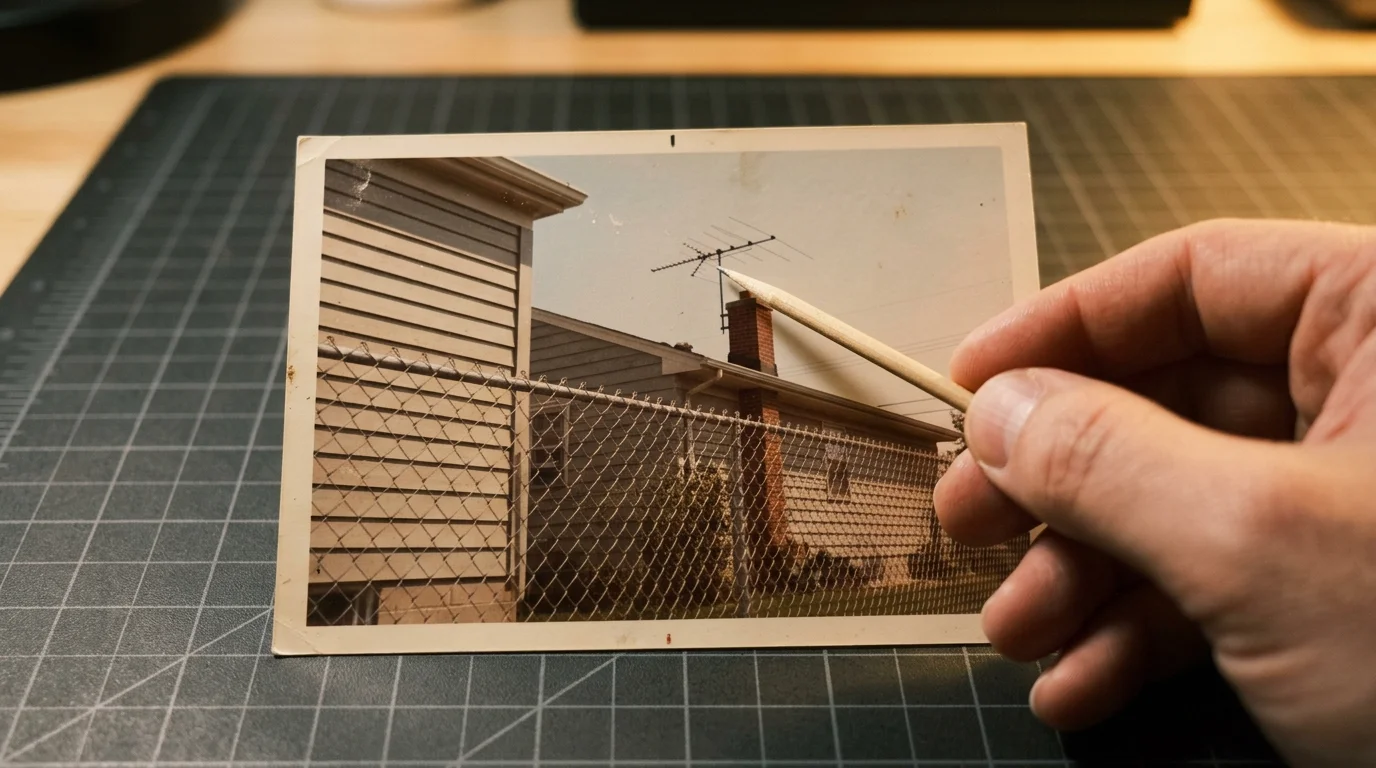
Driveway snapshots frequently record the front facade of a family home. Residential building materials offer precise chronological data points that corroborate your automotive and sartorial findings.
Pre-war homes built in the 1920s and 1930s commonly featured narrow beveled cedar clapboard siding. This material displayed a small 3.5-inch to 4.5-inch weather exposure between horizontal shadow lines.
Post-war suburban developments like Levittown revolutionized exterior cladding after 1947. Builders abandoned slow, labor-intensive narrow wood siding in favor of wide, mass-produced materials.
Look for wide-reveal cedar siding or pressed hardboard displaying an 8-inch to 10-inch exposure. Wide exterior horizontal lines strongly indicate residential construction or modern remodeling executed after 1948.
Asbestos-cement siding shingles gained immense market share for budget-friendly post-war suburban additions. These rigid shingles feature distinct wavy bottom edges and simulated embossed wood-grain textures.
Rooflines provide another clear clue when identifying the era of vintage photos. Low-pitched ranch-style roofs with wide overhanging eaves emerged in suburban tract developments starting around 1950.
Examine the rooftop skyline directly behind family gatherings for television antennas. Commercial television broadcasting expanded across metropolitan regions between 1947 and 1953.
A rooftop conical or multi-element Yagi television antenna confirms a photograph post-dates 1948. Homes displaying complex multi-bay aerial arrays with motorized rotators typically date to 1952 or later.
Backyard infrastructure changed rapidly during the post-war suburban boom. Traditional heavy wooden T-post clothesline frames yielded to umbrella-style rotary clothes dryers made from lightweight tubular aluminum.
Scalloped concrete curb stones, metal chain-link fencing with loop-top decorative post caps, and ornamental wrought-iron porch posts characterize residential properties updated between 1951 and 1959.
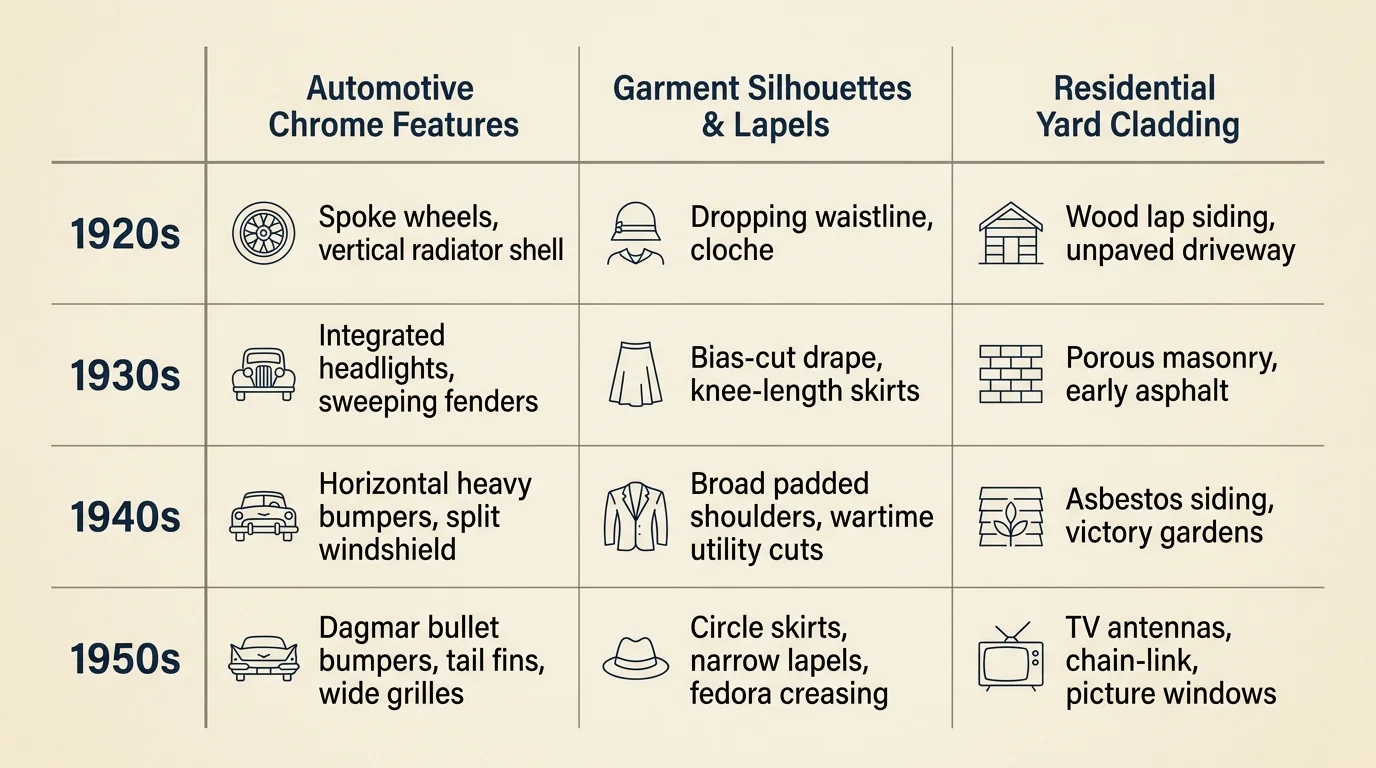
A Systematic Cross-Referencing Matrix for Mid-Century Prints
Use this physical reference matrix to compare details from your prints. When attributes line up horizontally across a single row, you achieve an exceptionally high dating confidence score.
| Era | Automotive Design Markers | Female Silhouette | Male Tailoring | Home Exterior Features | Date Precision |
|---|---|---|---|---|---|
| 1920–1929 | Upright flat radiator shell; wood-spoke wheels; freestanding headlights on crossbars. | Dropped waistline; tubular silhouette; cloche hat; knee-length hem (1926–1927 only). | High 4-button jacket; 22-inch Oxford bag trousers; center-creased fedora. | 4-inch reveal wood siding; double-hung multi-pane sash windows; wooden screen doors. | ± 2 Years |
| 1930–1939 | Sloping grille; steel Turret Top (1935+); headlights sinking into front fenders. | Natural waistline; bias-cut cling; soft shoulder curls; calf-length hem. | Broad double-breasted jacket; wide pointed peak lapels; cuffed wide trousers. | Cotswold brick detailing; arched entry doors; textured stucco finishes. | ± 2 Years |
| 1940–1946 | Sealed-beam round headlights; horizontal grille bars; blackout painted trim (1942). | Boxy square-padded shoulders; knee-length A-line skirt; rolled pompadour hair. | Single-breasted jacket; narrow notch lapels; cuffless trousers (L-85 rules). | Minimalist Cape Cod styling; wartime blackout shades; painted cinderblock foundations. | ± 1.5 Years |
| 1947–1953 | Pontoon slab body (1949+); split windshield; heavy chrome bullet bumper guards. | Dior New Look; cinched waist; massive crinoline petticoats; mid-calf full skirt. | Bold Look; 4-inch wide hand-painted tie; heavy shoulder pads; double pleats. | Early conical television antenna; 8-inch wide clapboard; asbestos-cement shingles. | ± 1 Year |
| 1954–1960 | Wraparound windshield; tail fins; two-tone side sweeps; quad headlights (1958+). | Pencil sheath skirt; pedal pushers; cat-eye frames; bouffant beehive hair (1959+). | Ivy League 3-button jacket; natural shoulders; 2-inch skinny tie; flat-front pants. | Low-pitch ranch roof; wrought-iron porch columns; aluminum rotary clothes dryer. | ± 1 Year |
Notice how design elements change in synchronization across unrelated industries. Industrial tooling, textile mills, and residential architecture all responded to the same cultural and economic events.
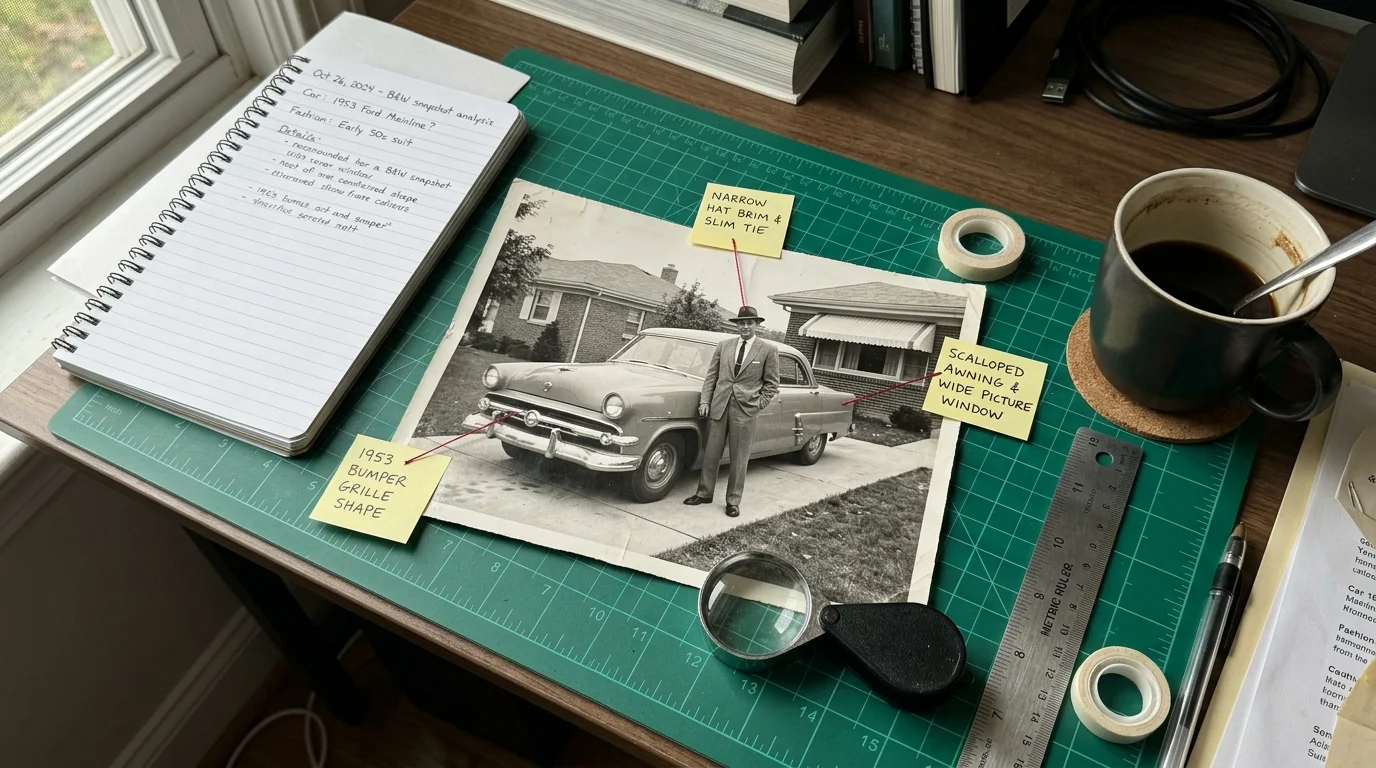
Worked Dating Scenario: Deconstructing an Unlabeled 1953 Driveway Print
Consider an actual family historian workflow sorting through an inherited collection. You hold an unlabeled, black-and-white gelatin silver print measuring exactly 3.5 inches by 5 inches with deckled border edges.
The print depicts a family of four posing beside a shiny four-door sedan in a gravel driveway. You mount the photograph beneath a daylight desk lamp and examine the frame using an 8x loupe.
First, inspect the vehicle sheet metal. The car displays a curved, one-piece windshield without a central divider bar, ruling out general production from 1951 or earlier.
The front grille features a heavy horizontal chrome bar with three integrated bullet teeth and a central round medallion. This specific arrangement identifies the vehicle as a 1953 Chevrolet Bel Air four-door sedan.
General Motors introduced this restyled Chevrolet body in October 1952 for the 1953 model year. Therefore, your absolute earliest theoretical shutter exposure date is October 1952.
Second, examine the adult male standing beside the front fender. He wears a two-piece wool flannel suit with a single-breasted two-button front stance.
Measure the lapel across its widest point using a millimeter scale. The lapel measures 3.25 inches across, while his geometric rayon necktie measures 3.5 inches wide, hitting just above his belt buckle.
This lapel and tie combination marks the exact transition between the late 1940s Bold Look and the late 1950s Ivy League cut. This transition flourished commercially between 1952 and 1954.
Third, observe the adult female sitting on the car’s front fender. She wears a three-quarter sleeve cardigan sweater buttoned up over an expansive, pleated cotton circle skirt.
The hemline hangs precisely eleven inches above the driveway, falling midway between her knees and ankles. The skirt flares outward smoothly over several stiff petticoat layers, representing mainstream acceptance of the Dior silhouette.
Fourth, inspect the home in the background. The chimney carries a dual-bay conical television antenna supported by guy wires, while the house shows horizontal siding with an 8.5-inch reveal.
The local television station serving this family’s confirmed county in Ohio began commercial broadcasting in December 1949. The antenna confirms the photograph post-dates that local tower activation.
Fifth, examine the photographic paper stock itself. The print features deckled, scalloped edges on Kodak Velox paper, a finishing style common among commercial photo labs between 1950 and 1955.
Synthesizing these data points produces an indisputable window. The 1953 Chevrolet establishes the terminus post quem of October 1952, while the tie width, deckled borders, and skirt length fade by late 1955.
You can record this print in your family archive database as: “Circa May 1953 to September 1954.” You have reduced a loose forty-year window down to sixteen probable months.

Archival Handling and Non-Destructive Documentation Procedures
Once you deduce an accurate date, you must record your findings without harming the physical artifact. Never apply modern self-adhesive labels, clear tape, or standard ballpoint pens to vintage photographs.
Ballpoint ink contains volatile solvents and acidic dyes that bleed through paper fibers over time. The pressure of a rolling ballpoint tip leaves permanent indented furrows in the emulsion on the image side.
Use a soft, pure graphite pencil—specifically a 2B or 4B hardness grade—to record dates on the reverse side. Graphite remains chemically inert and does not transfer chemicals into adjacent prints inside storage boxes.
Write strictly along the outer white margin on the reverse side of the print. Place the print face-down upon a smooth, clean glass surface to avoid embossing the front photographic emulsion.
Reversible documentation protects heirloom photographs; chemical contamination from ballpoint pens causes irreversible degradation over decades of dark storage.
Wear clean, powder-free nitrile gloves when handling prints from the 1920 to 1960 era. Nitrile prevents skin oils and acidic perspiration from transferring onto delicate gelatin silver emulsions.
For conservation standards, review preservation guidance from the Library of Congress Preservation division. They outline temperature thresholds and environmental controls that halt chemical degradation in paper prints.
Store your dated prints inside individual archival enclosures made from unbuffered acid-free, lignin-free paper or inert plastic. Suitable inert plastics include polyester (Mylar), polypropylene, or polyethylene.
Avoid cheap vinyl or polyvinyl chloride (PVC) photo sleeves commonly sold in vintage albums. PVC releases hydrochloric acid gas and oily plasticizers as it degrades, dissolving photographic emulsions within a decade.
Digitize your prints at high resolution before storing them permanently in archival boxes. Scan black-and-white prints at 600 to 1200 DPI in uncompressed 16-bit TIFF format to capture fine background details.
Consult professional preservation protocols published by the American Institute for Conservation to select appropriate archival enclosures. Their standards help family historians choose safe materials that pass the Photographic Activity Test (PAT).
Frequently Asked Questions
How do I date a photo if the car pictured was purchased used?
An automobile establishes a strict terminus post quem, meaning the photo cannot predate the vehicle’s manufacturing year. To detect used-car lag, cross-reference vehicle wear, rust, and outdated body styles against current clothing silhouettes and modern home fixtures.
Can photo paper development stamps determine the exact print date?
Development stamps on white print borders typically show month and year codes like “AUG 54” or manufacturer watermarks. These stamps date the photographic printing process rather than the exact shutter exposure, though they usually match within weeks.
What should I do if clothing silhouettes contradict the vehicle model year?
Always defer to the newest manufactured object in the frame to establish your baseline earliest date. Clothing styles often lag in rural or older populations, but a vehicle body line never precedes its factory production date.
How do television antennas narrow photographic timelines?
Rooftop television antennas appeared rapidly in American suburbs between 1948 and 1953 as regional broadcast towers opened. Conical and Yagi antenna arrays confirm a post-1948 capture date, especially on homes built before World War II.
Disclaimer: This article is for informational purposes only. When handling valuable or irreplaceable photographs, consider consulting a professional conservator. Always test preservation methods on non-valuable items first.