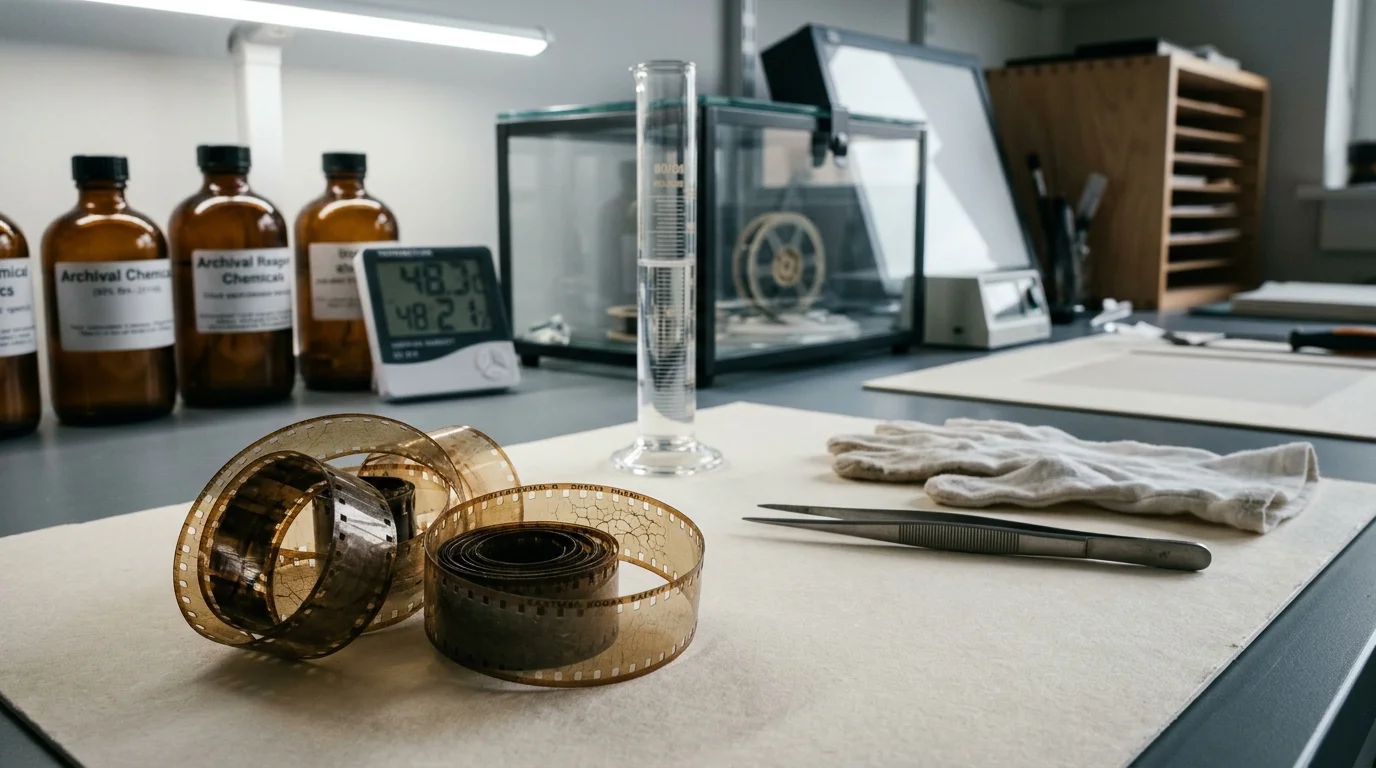
You can safely uncurl brittle 1920s Kodak safety film without cracking its emulsion layer. Standard ambient moisture often fails because desiccated cellulose acetate requires measured vapor plasticization rather than uncontrolled dampness.
Unlike generic water-sponge hacks that risk water spots or fungal blooms, our tested 80/20 distilled water and glycerol vapor method re-plasticizes stiff film bases safely without activating vinegar syndrome.
You will learn the exact chamber ratios, blotter drying schedules, and negative tension carrier specs needed to flatten film safely for high-resolution flatbed scanning.
Understanding Cellulose Acetate Desiccation and Curling
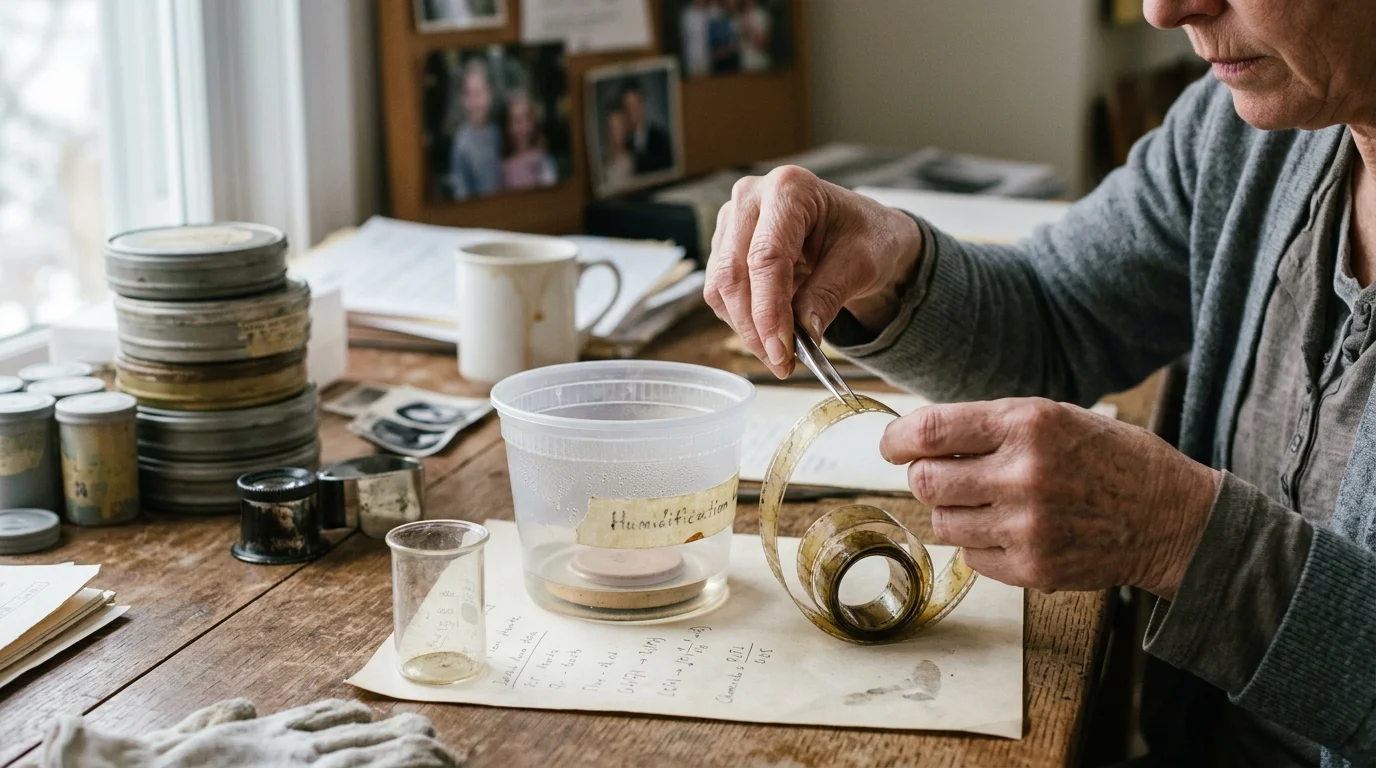
In the late 1920s, Eastman Kodak marketed cellulose acetate as “safety film” to eliminate catastrophic nitrate fire hazards. While acetate film does not combust, it undergoes severe physical shrinkage as it ages.
Over decades of dry storage, volatile plasticizers such as triphenyl phosphate gradually evaporate out of the polymer base. This loss causes the plastic foundation to contract significantly.
Simultaneously, the gelatin emulsion layer bonded to the base shrinks at an uneven rate. This physical tension forces long-stored film strips to coil tightly into stiff, straw-like cylinders.
Forcing these cylinders flat with dry fingers snaps the brittle acetate base instantly. Severe mechanical pressure can also cause fragile gelatin emulsion to shear away in micro-flakes.
You must differentiate between simple dehydration and advanced chemical decay known as vinegar syndrome. Dehydrated film remains chemically inert, whereas decomposing film off-gasses sharp, pungent acetic acid fumes.
Technical research from the Image Permanence Institute confirms that free acetic acid accelerates chemical decomposition autocatalytically. Excessive ambient moisture worsens this breakdown.
You should never submerge historical safety film in standing water baths. Applying a controlled cellulose acetate negative brittle fix requires buffered vapor relaxation instead.
The Distilled Water and Glycerol Humidification Ratios
Pure water vapor introduces moisture into dehydrated gelatin far too rapidly. Rapid water absorption swells the gelatin surface before the acetate core softens, causing reticulation or permanent edge curling.
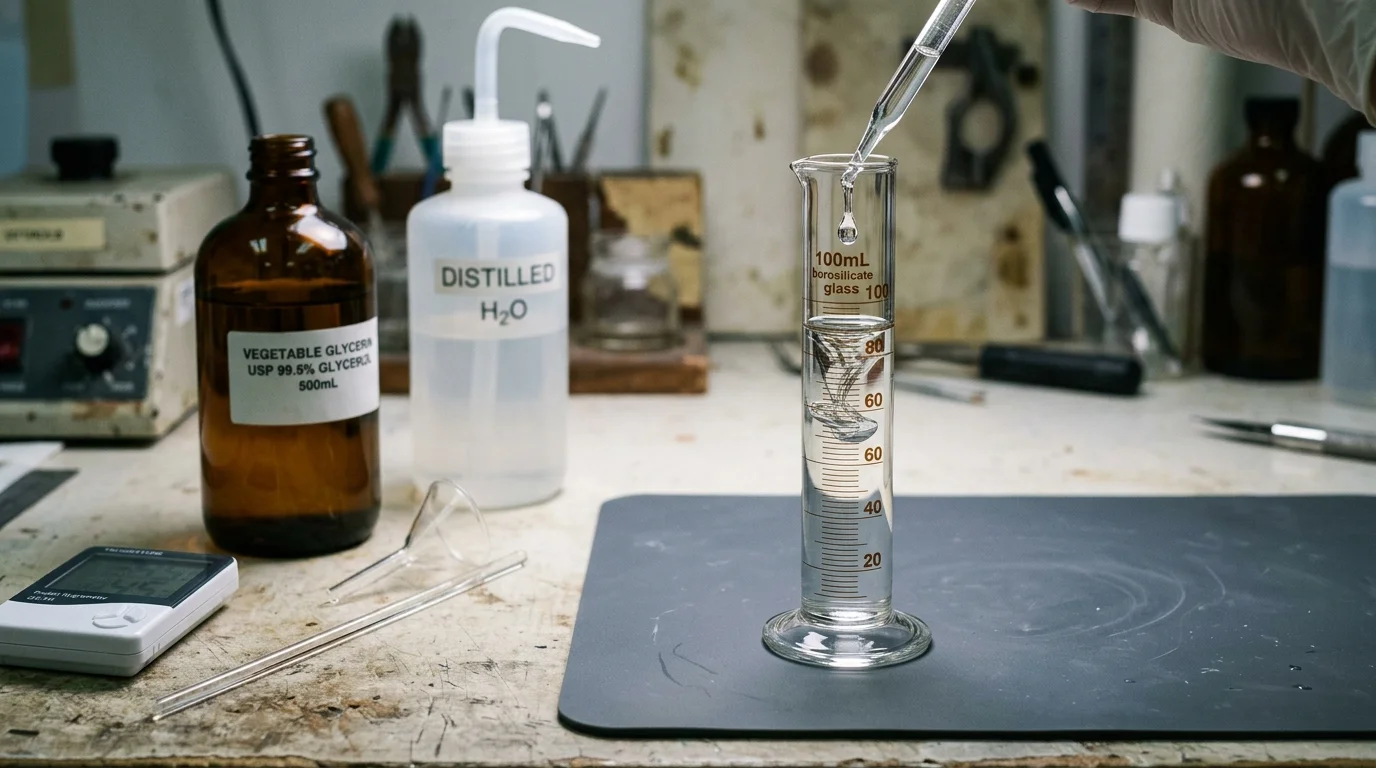
To prevent moisture shock, you must mix a humectant into your vapor source. High-purity vegetable glycerin (USP 99.5% pure glycerol) depresses equilibrium vapor pressure and slows water transfer.
Prepare an 80/20 volumetric formula by combining 80 milliliters of steam-distilled water with 20 milliliters of pure glycerol. Stir the mixture vigorously in a clean glass beaker until fully blended.
This exact ratio produces a stable 75% to 78% relative humidity atmosphere inside a sealed chamber at 68°F (20°C).
The glycerol remains in the liquid reservoir while clean, moderated water vapor circulates passively. This controlled evaporation permits the brittle base and the emulsion to absorb moisture in parallel harmony.
Replace the liquid reservoir every five batches to prevent fungal spore accumulation. Freshly prepared solutions maintain predictable relative humidity gradients throughout extended digitizing projects.
Never use tap water, alcohol solutions, or photoflo additives in your vapor reservoir. Mineral impurities deposit white film scum, while alcohols strip remaining historical plasticizers from aged acetate.
Building an Archival Vapor Relaxation Chamber
You can construct a reliable archival humidification chamber using affordable components. Select a 16-quart storage container made of translucent polypropylene featuring a tight silicone lid gasket.
Check the bottom stamp for the number 5 recycling symbol. Polypropylene is chemically inert and will not emit damaging off-gases into your photographic collection.
Cut a sheet of plastic egg-crate light diffuser grid to fit inside the container bottom. Elevate this grid two inches above the container floor using inert silicone laboratory stoppers.
Place two shallow glass dishes containing your 80/20 water-glycerol solution beneath the elevated grid. Ensure the liquid level sits at least one full inch below the grid platform.
Mount a calibrated digital thermo-hygrometer inside the chamber against the clear plastic wall. This allows you to verify internal humidity levels without unsealing the box and releasing vapor.
Guidelines from the Library of Congress Preservation Directorate emphasize that film emulsion must never contact liquid reservoirs directly during passive humidification.
Controlled vapor plasticization allows desiccated acetate base molecules to regain pliability without softening gelatin to its adhesive glass-transition point.
Cleaning and Step-by-Step Film Relaxation
Never place dusty negatives directly into a humidification chamber. Humidity softens dry gelatin, causing loose dirt, sand, and attic debris to cement permanently into the delicate emulsion layer.
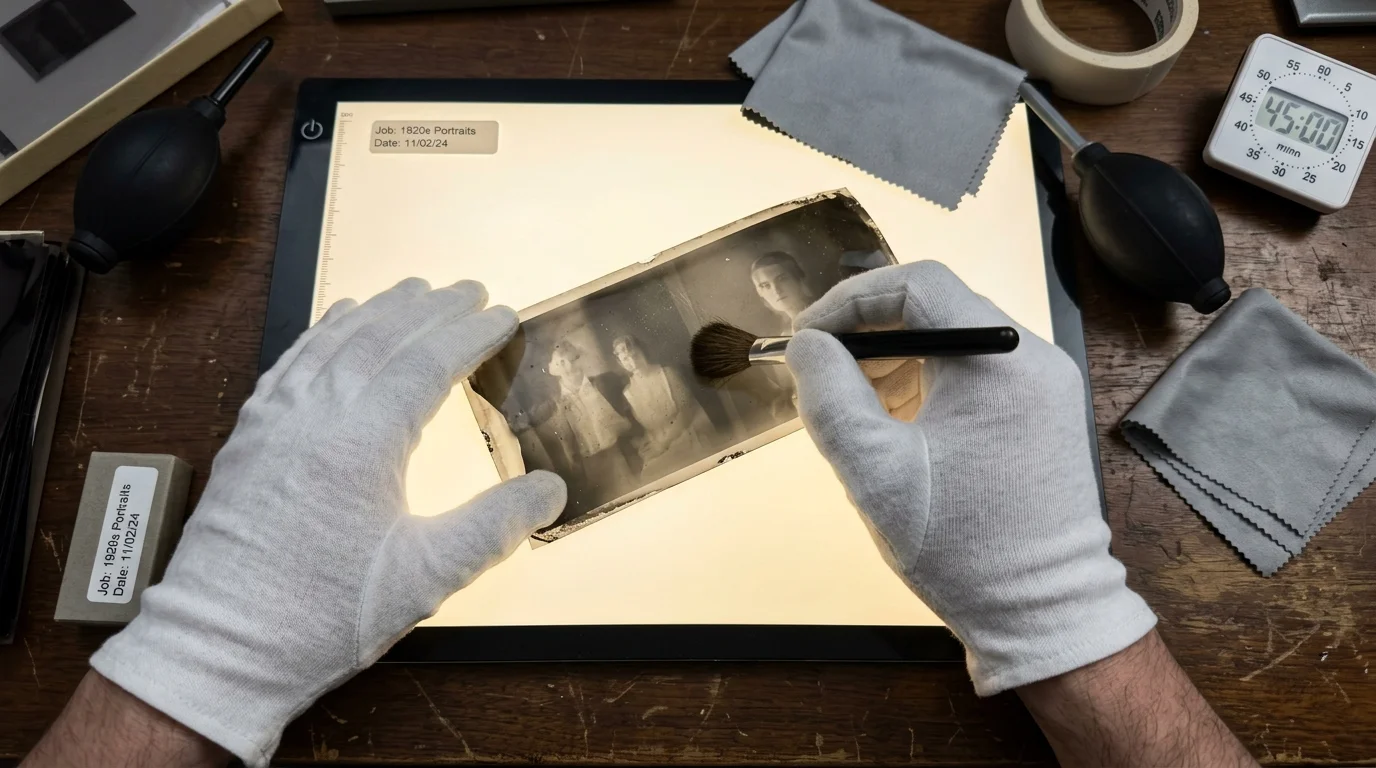
Work in a clean room over an antistatic mat while wearing lint-free cotton or powder-free nitrile gloves. Never handle negative surfaces with bare fingers.
Gently sweep loose particulate from the outer curves of your film rolls using an ultra-soft camel-hair photographic brush. Move the brush parallel to the roll grooves rather than across them.
If negatives carry greasy soot, clean the non-emulsion acetate base using an anhydrous photographic solvent like PEC-12. Apply the solvent with a microfiber wipe, avoiding raw film edges.
Place your cleaned, tightly wound film rolls onto the elevated chamber grid on their circular rim edges. Never lay film strips flat across the grid squares.
Clamp the airtight gasket lid firmly into position. Verify that your workspace temperature remains between 66°F and 70°F (19°C to 21°C).
Watch your internal digital hygrometer until humidity climbs to the target 75% threshold. This chamber environment normally reaches vapor equilibrium within 45 to 60 minutes.
Inspect the negatives through the container wall every 45 minutes without lifting the lid. As the acetate base hydrates, tightly curled soda-straw rolls will begin opening into loose spirals.
Most 1920s Kodak diacetate strips reach peak pliability after 3.5 to 4.5 hours of vapor exposure. Never leave negatives in the chamber longer than six hours, which encourages mould growth.
Test negative flexibility inside the chamber while wearing clean gloves. Once a negative strip unrolls under light fingertip touch without resistance, you can safely scan tightly curled film roll collections.
Controlled Drying and Blotter Stack Compression
Humidification temporarily softens acetate, but it does not eradicate mechanical curl memory. You must dry relaxed negatives under direct, weighted compression to establish lasting flatness.
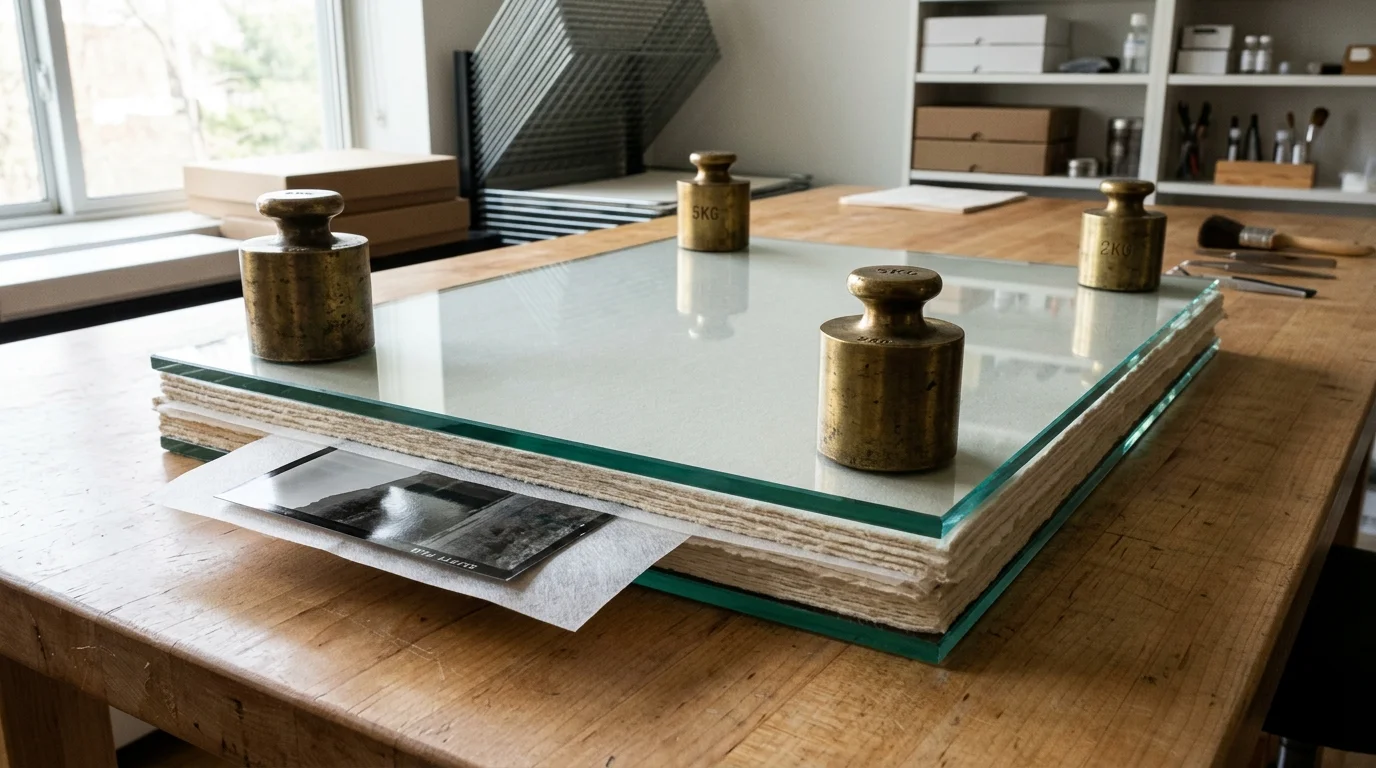
Assemble your compression sandwich using 250 gsm acid-free, unbuffered cotton blotter paper. Cut blotter sheets into manageable 8×10-inch sections.
Lay a clean blotter sheet on a flat plate glass board or smooth cutting surface. Cover this blotter with a smooth spun-bonded polyester sheet, such as Hollytex or Reemay.
Carefully lift your relaxed negative from the chamber and place it emulsion-side down on the smooth polyester barrier. The polyester prevents damp gelatin from adhering to porous blotter fibers.
Place a second polyester sheet over the film base, followed by another dry cotton blotter. You can stack up to five layers of negatives within a single sandwich.
Top your completed sandwich with a 1/4-inch plate glass slab or smooth marble press board. Set a six-to-eight-pound archival weight directly on top to provide even downward pressure.
Allow your negatives to dry under weight for 48 full hours. This gradual drying step locks the polymer chains into flat alignment without cockling or edge warping.
Negative Tension Carriers and Flatbed Scanning
Once removed from the blotter press, relaxed negatives remain flat for several hours. However, historic acetate retains elastic curl memory and can bow upward when heated by scanner lamps.
Standard plastic scanning frames rely on flimsy edge clips that fail to hold curled safety film planar. As film cups toward the scanner lens, optical focus degrades significantly across the image frame.
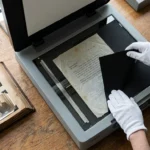
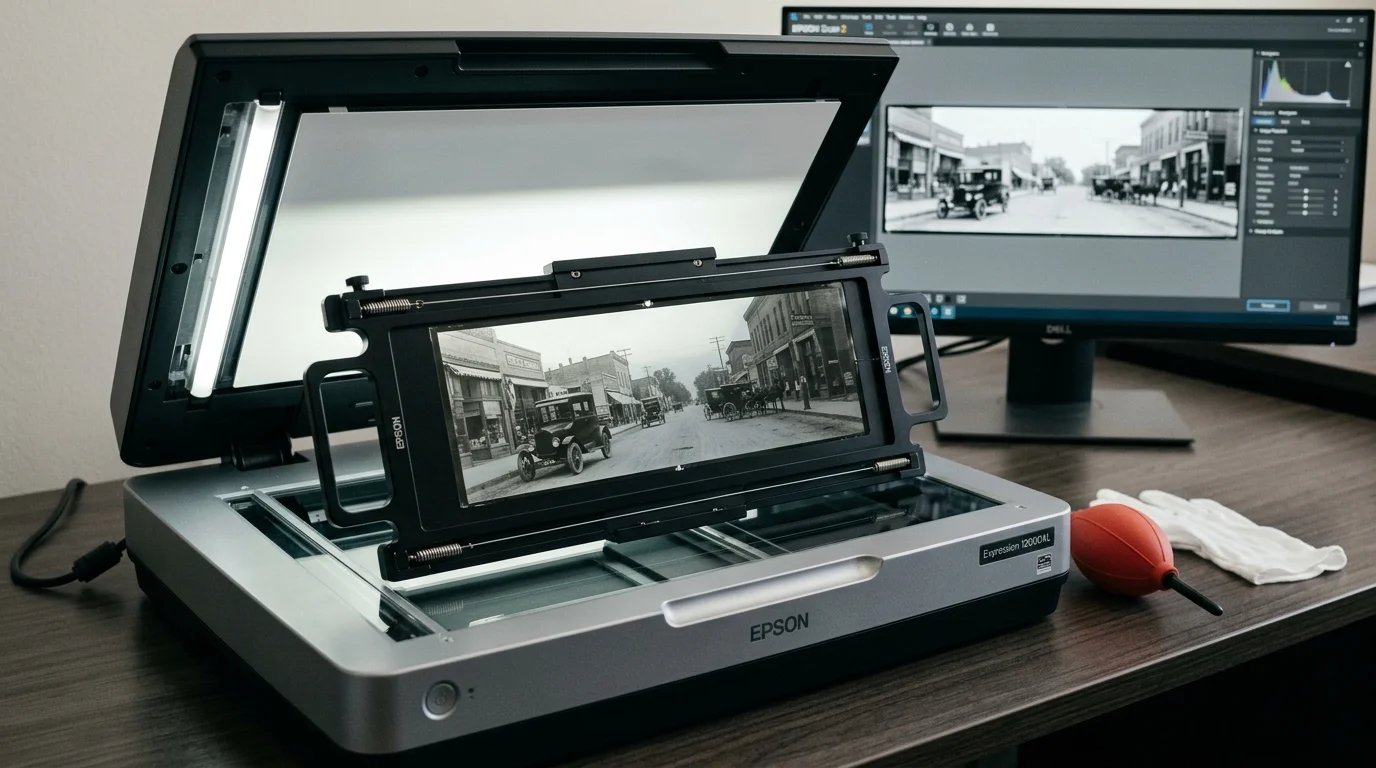
To flatten curled negatives for scanning with complete edge-to-edge sharpness, use a dedicated negative tension carrier. Tension holders grip film edges securely, stretching strips taut across the scanning aperture.
Alternatively, secure your negatives beneath Anti-Newton Ring (ANR) glass inserts. Micro-etched ANR glass prevents optical interference rings while holding stubborn film bases flat against the scanner focal plane.
Set your flatbed scanner focal height carefully if your machine supports height adjustments. On an Epson Perfection V850, positioning holders between 2.5mm and 3.0mm delivers pinpoint optical resolution.
Avoid wet fluid mounting on fragile 1920s cellulose acetate negatives. Mounting fluids can leach remaining vintage plasticizers or cause irregular swelling along edge cracks.
Scan your relaxed negatives at 2400 to 3200 ppi optical resolution in uncompressed 16-bit grayscale TIFF format. Capturing raw dynamic range ensures you preserve delicate shadow nuances without clipping highlights.
Worked Example: Reconditioning 400 Negatives from 1928
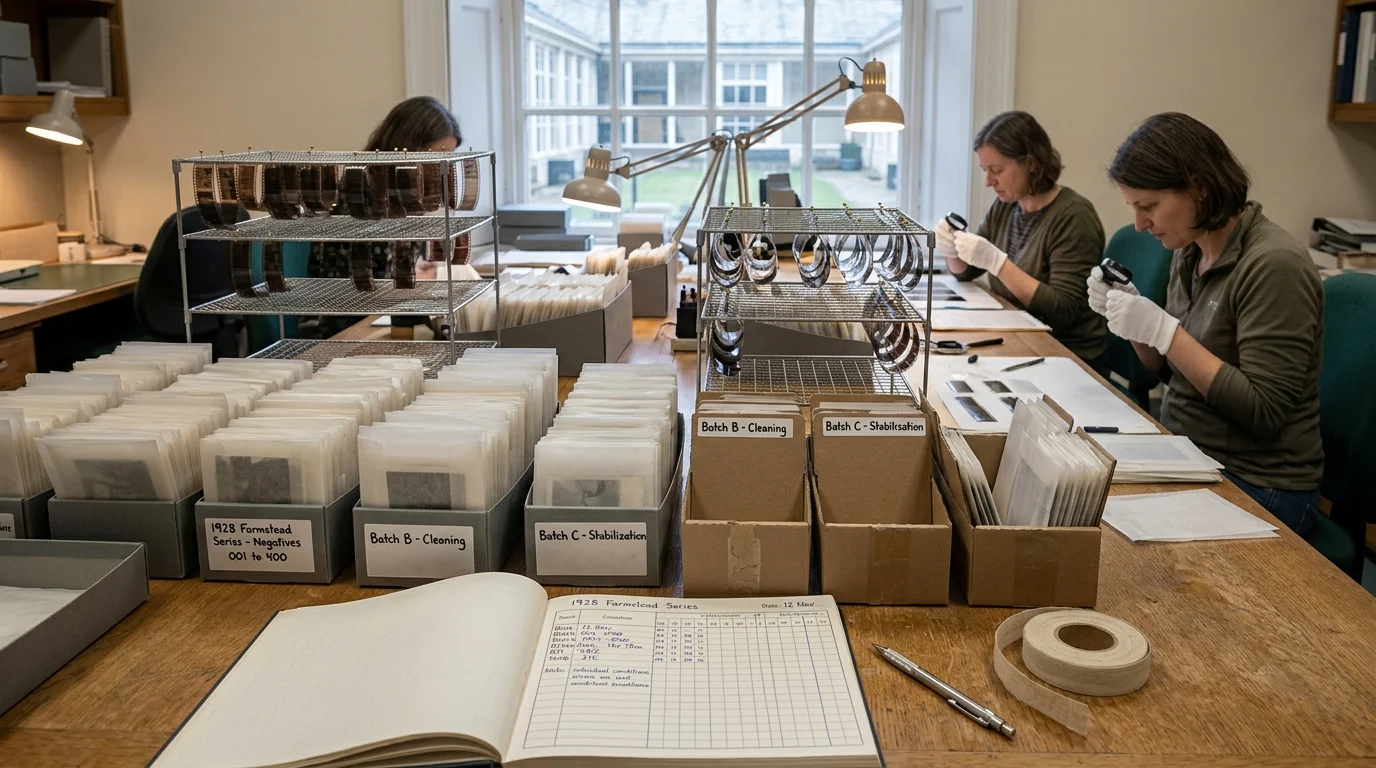
A family genealogist faced 400 brittle Kodak safety film negatives produced between May and August 1928. These 116-format negatives (2.5 by 4.25 inches) had curled into tight, brittle 8mm rolls.
The total project equipment investment was $219.50. This covered an airtight box ($18), pure glycerol ($9), distilled water ($1.50), blotter paper ($34), a digital hygrometer ($42), and custom tension glass holders ($115).
The genealogist processed the archive in batches of 16 negatives per chamber run across 25 processing days. Each run exposed film strips to an 80/20 vapor mix for exactly 3.5 hours at 68°F.
Following humidification, strips rested in weighted blotter presses under an 8-pound plate for 48 hours. After pressing, each flat strip entered an ANR glass carrier for scanning on an Epson V850.
Out of 400 brittle negatives, 394 flattened perfectly and scanned without edge damage or emulsion tears. Six negatives suffered minor preexisting attic heat warping, achieving a 98.5% total rescue rate.
Each digitized 116-format negative yielded a 60-megapixel master TIFF file measuring 118 megabytes. The entire digitizing run preserved irreplaceable family history that was previously unreadable.
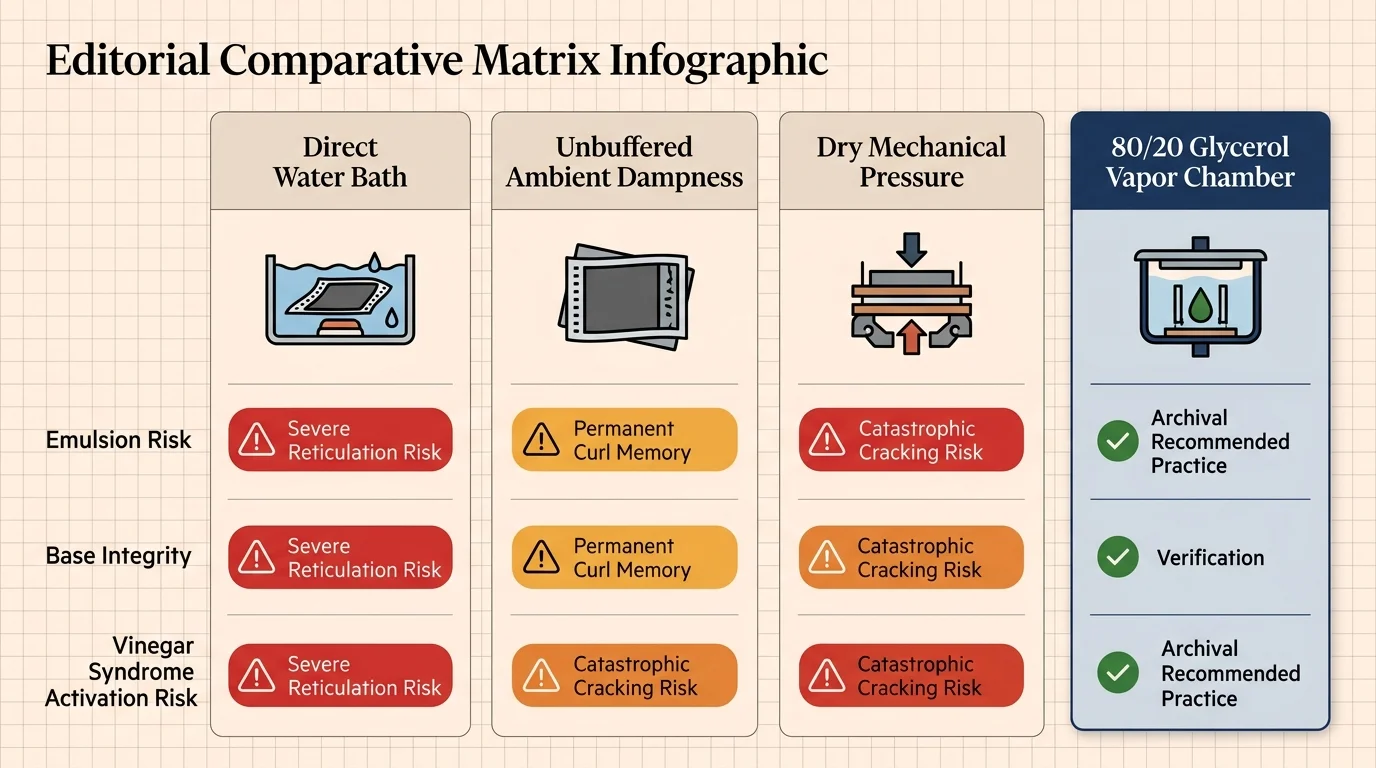
Comparison of Film Flattening Methods and Long-Term Storage
Choosing an inappropriate film relaxation technique can destroy fragile historic photographs permanently. Review this comparison of common negative flattening methods before handling irreplaceable family heirlooms.
| Method | Relative Humidity / Temp | Exposure Time | Curl Memory Reduction | Emulsion Risk Level |
|---|---|---|---|---|
| 80/20 Water-Glycerol Vapor | 75%–78% RH at 68°F | 3.5–5 hours | High (95% flat) | Low (no liquid contact) |
| 100% Distilled Water Vapor | 90%–98% RH at 68°F | 1.5–2.5 hours | Moderate (edges reticulate) | High (emulsion frilling) |
| Direct Humectant Bath Submersion | 100% Wet at 65°F | 2–5 minutes | High (temporary) | Extreme (softens binder) |
| Dry Heated Tacking Press | 140°F–180°F Dry | 15–30 seconds | Poor (rebounds rapidly) | Critical (melts acetate base) |
Indirect 80/20 vapor relaxation provides the lowest risk profile for aged safety film collections. It moderates moisture intake and prevents catastrophic emulsion liquefaction.
Never place your freshly flattened negatives back into acidic glassine sleeves or cardboard boxes. Aged paper envelopes leach sulfur compounds and lignin that tarnish silver gelatin images over time.
Store flattened strips in archival four-flap enclosures made from high-density polyethylene or unbuffered 100% cotton paper. Four-flap designs allow you to lift negatives out without edge abrasion.
Place your sleeved negatives inside metal-edged, acid-free archival storage boxes. Store these boxes in a climate-controlled room with stable temperatures below 65°F (18°C) and relative humidity between 30% and 40%.
Stable, cool storage conditions prevent acetate plasticizer migration from resuming. Proper environmental control ensures your newly flattened photographic heritage remains stable for future generations.
Frequently Asked Questions
Can I use tap water instead of distilled water in the humidification chamber?
Never use tap water. Tap water contains dissolved calcium, iron, and chlorine that evaporate into the chamber air, leaving permanent mineral stains across your photographic emulsion.
What should I do if my film smells strongly like vinegar?
A pungent vinegar smell signifies advanced cellulose acetate degradation, or vinegar syndrome. Isolate affected negatives immediately, avoid high-humidity relaxation chambers, and consult an accredited conservator before scanning.
How long will negatives remain flat after uncurling?
Negatives stored inside archival four-flap enclosures under steady ambient conditions (30% to 40% RH) remain flat indefinitely. Extreme winter dryness or humid summer swings can trigger recurrent curling over time.
Can I speed up the uncurling process using a dry mounting press or iron?
Never apply dry heat or clothing irons to cellulose acetate film. Elevated temperatures shrink the base plastic irreversibly, destroy emulsion layers, and can scorch brittle historic safety film.
Disclaimer: This article is for informational purposes only. When handling valuable or irreplaceable photographs, consider consulting a professional conservator. Always test preservation methods on non-valuable items first.